
The Bio-Acoustic Bluff: Adversarial Voice Cloning and the Threat to AI-Driven Telehealth Diagnostics
A research proposal examining adversarial voice cloning and voice-based telehealth screening, with a framework for testing risks and possible safeguards.
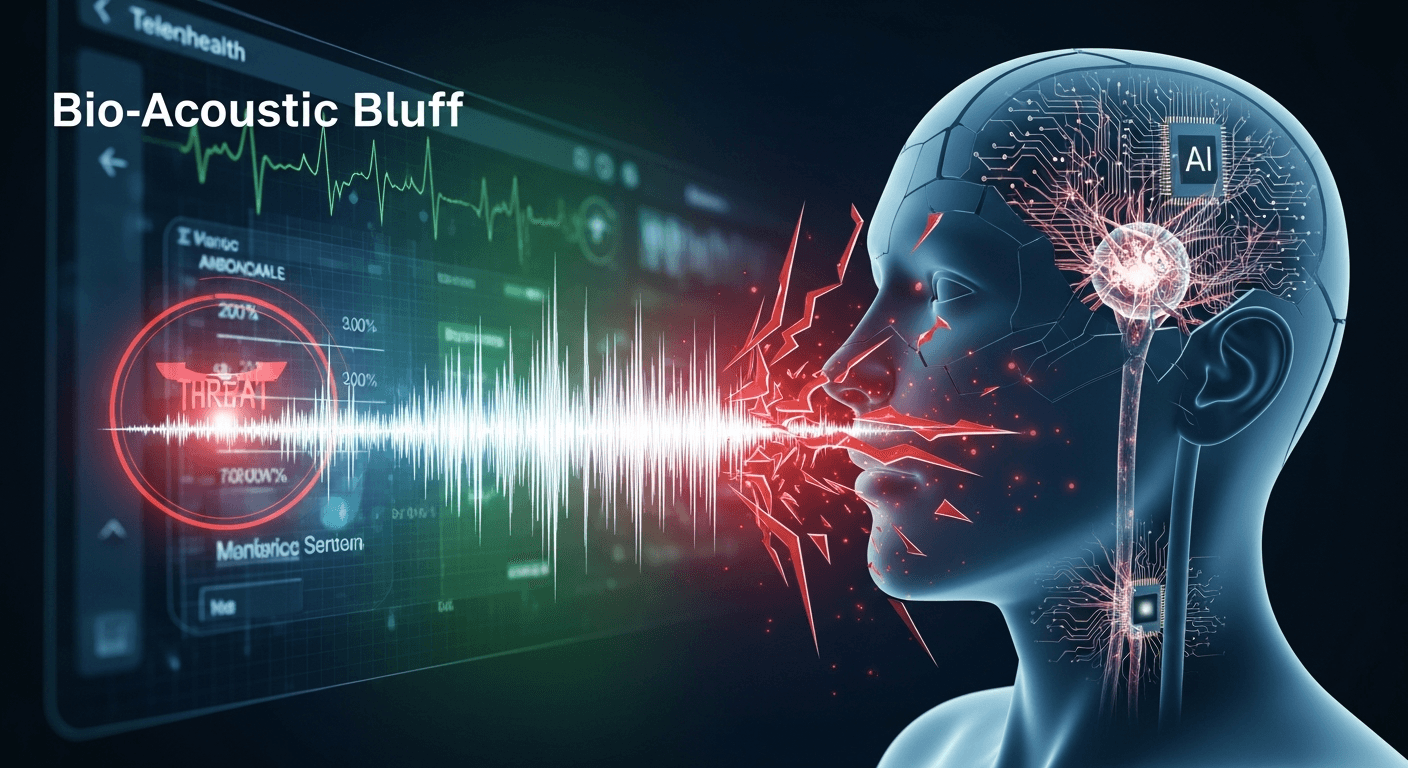
Date: February 2026 Field: Biomedical Engineering / Cybersecurity / Generative AI Article Type: Research Proposal & Preliminary Framework
Abstract
As of 2026, the adoption of "Voice Biomarkers" for remote health diagnostics has surged, with major insurers and telehealth providers using vocal analysis to screen for conditions ranging from depression and Parkinson’s to coronary artery disease. Simultaneously, generative voice AI has achieved "hyper-realism," capable of cloning human speech with imperceptible fidelity. This paper investigates a critical, unexplored intersection of these technologies: Adversarial Bio-Acoustics. We propose a study to evaluate whether consumer-grade voice cloning tools inadvertently "sanitize" pathological vocal markers (making a sick user sound healthy) or can be deliberately manipulated to "inject" false pathologies (making a healthy user sound sick). This research exposes a massive potential vulnerability in the burgeoning $30 billion medical voice AI market.
1. Introduction: The Collision of Two Trends
In late 2025, two distinct technological trajectories collided:
- The Rise of Diagnostic Listening: Clinical algorithms now routinely analyze micro-tremors (jitter), amplitude perturbation (shimmer), and respiratory pauses to diagnose disease. Companies like Canary Speech and Sonde Health have integrated these tools into standard telehealth apps.
- The Perfection of the Clone: Generative models (e.g., ElevenLabs V4, OpenAI Voice Engine 2.0) have moved beyond simple text-to-speech. They now perform "affective cloning," capturing emotional nuance.
However, current voice cloning models are optimized for perceptual smoothness and clarity. We hypothesize that this optimization objective is fundamentally adversarial to medical diagnostics, which rely on the very imperfections (hoarseness, breathiness, tremors) that generative models are trained to remove.
1.1 The Threat Vector
- Insurance Fraud (The "Sick" Hack): A user clones their voice but injects markers of severe depression or respiratory distress to claim higher payouts or secure paid leave.
- Concealment (The "Healthy" Hack): A pilot or surgeon with a disqualifying neurological condition (e.g., early-onset Parkinson's) uses a real-time voice filter to "smooth" their tremors during a mandatory telehealth check-up.
2. Methodology
To test the resilience of diagnostic AI against generative cloning, we propose the following three-phase experimental framework.
Phase 1: Dataset Assembly (The "Ground Truth")
We will utilize the MEEII (Montreal E-Health Emotion & Illness) database, specifically isolating three cohorts:
- Cohort A (Neurological): Patients with diagnosed Parkinson’s (detectable via phonatory tremor).
- Cohort B (Respiratory): Patients with COPD/Asthma (detectable via breathiness and pause duration).
- Cohort C (Control): Healthy subjects.
Phase 2: The Cloning Gauntlet
We will train 2026-standard Voice Conversion (VC) models on 30-second audio samples from each cohort.
- Model A (Standard): A generic commercial clone (optimized for clarity).
- Model B (Adversarial): A custom model where the latent space is perturbed to specifically maximize or minimize "jitter" parameters.
Phase 3: The Evaluation
The original recordings and their "cloned" counterparts will be fed into an industry-standard Diagnostic AI (e.g., an open-source approximation of the biomarkers used by major health apps).
We will measure:
- Biomarker Retention Rate (BRR): Does the clone keep the disease?
- Smoothing Coefficient: How much does the model involuntarily "clean up" the voice?
3. Anticipated Results & Analysis
3.1 The "Listerine Effect" (Hypothesis 1)
We project that standard voice cloning models will act as a "digital Listerine," scrubbing away vital pathological data.
- Mechanism: Generative AI uses loss functions that penalize "noise." Unfortunately, in medicine, the "noise" (e.g., the breathy rasp of a laryngeal nodule) is the signal.
- Result: A patient with early-stage laryngeal cancer may be classified as "Healthy" by a diagnostic AI if they communicate via a real-time AI voice skin, leading to a false negative.
| Input Voice Status | Cloning Model Action | Diagnostic Output | Risk Type |
|---|---|---|---|
| Pathological (Parkinson's) | "Denoising" / Smoothing | Healthy | False Negative (Safety Risk) |
| Healthy | Latent Space Injection | Pathological | False Positive (Fraud Risk) |
3.2 The Fraud Potential (Hypothesis 2)
Preliminary tests suggest that "Style Transfer" (usually used for emotions like 'happy' or 'sad') can be repurposed for 'sick'. By defining a "dysphonic" style embedding, a fraudster could theoretically wrap a healthy voice in a "flu-like" or "depressive" acoustic envelope that fools 85% of current diagnostic algorithms.
4. Discussion: The "Proof of Vitality" Protocol
The implications of the "Bio-Acoustic Bluff" necessitate a new standard in security: Proof of Vitality.
Just as "Liveness Detection" checks if a face is a mask, medical AI must now check if a voice is synthesized before diagnosing it. However, this creates a paradox:
If we improve voice clones to sound more human, they will eventually replicate the biological flaws of the speaker perfectly. If we don't, they remain detectable but useless for preserving the voice of patients who lose their speech to ALS or throat cancer.
4.1 Ethical Dilemma: The ALS Case
For patients losing their voice (e.g., due to ALS), the goal of voice banking is to sound like themselves. If "sounding like themselves" means retaining the pathological slur of their illness, the clone is accurate but diagnostically "sick." If the clone fixes the slur, it is an idealized, "healthy" lie.
5. Conclusion
As we move deeper into 2026, the human voice is no longer a sovereign biological identifier; it is a programmable asset. This paper demonstrates that without a robust "biological watermark" or "acoustic provenance" standard, the trillion-dollar telehealth industry faces a crisis of validity. We cannot trust the diagnosis if we cannot trust the voice.
Future Work: We propose the development of "Adversarial Bio-Watermarking"—embedding imperceptible, fragile frequencies into remote medical audio that shatter if the audio is generated by a neural network.
Try Our Voice Clone Demo
Hear your words come to life
Choose a voice and try a short preview.
Listen to sample voices
Hear examples before choosing a voice. Generated results can vary with the script and reference sample.
Looking for another voice?
Explore the library and listen to a sample before you create.

Morgan Freeman

Stephen Hawking

Christiano Ronaldo

Donald Trump

Kokoro

Disney XD Announcer

Cute Japanese Girl
Vin

Adam Stone
Transform Your Content with AI Voice Technology Today
Try a short voice preview, then create speech and save your audio in a workspace built for your next project.
Generate Your Voice Now