
ElevenLabs: Commercial Success in Voice AI, But Not the Technical Leader
Explore the distinction between commercial voice AI products and speech research, including evaluation criteria, product strengths, and technical tradeoffs.
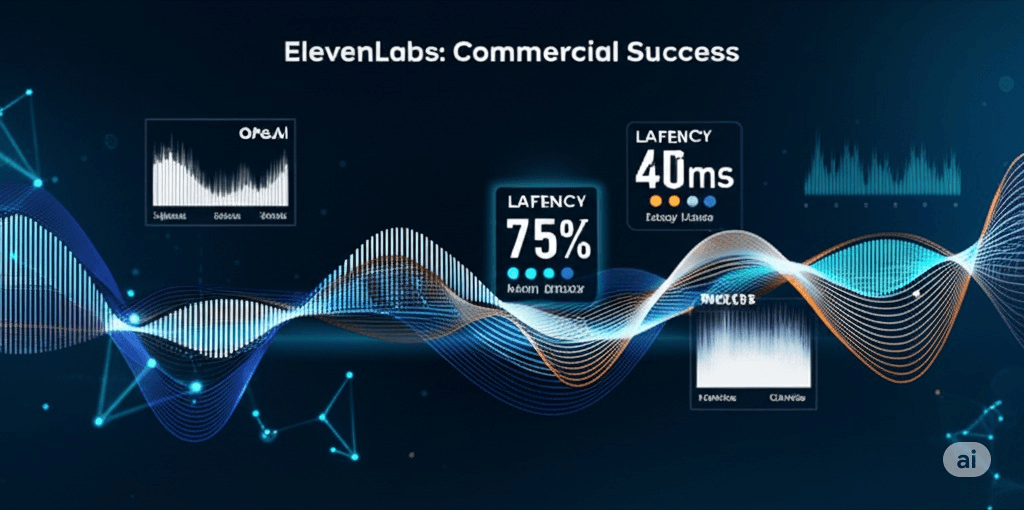
While ElevenLabs has achieved remarkable commercial success and built a thriving business around AI voice technology, it's important to understand their actual position in the broader landscape of voice AI research and development. The company has excelled at productizing voice synthesis technology and building a user-friendly platform, but they are not necessarily at the forefront of technical innovation compared to cutting-edge research models.
Commercial Excellence vs. Technical Leadership
ElevenLabs has built an impressive commercial operation around voice AI technology, achieving a $3.3 billion valuation by January 2025 and widespread adoption across Fortune 500 companies. However, their success stems more from excellent product development, user experience design, and market positioning rather than groundbreaking technical innovations that define the state-of-the-art.
The company was founded in April 2022 by Mati Staniszewski and Piotr Dąbkowski, motivated by frustrations with poor movie dubbing quality in Poland. This practical, user-focused origin story reflects their approach: taking existing voice AI techniques and packaging them into accessible, reliable products rather than pushing the boundaries of what's technically possible.
Where ElevenLabs Actually Stands Technically
Independent benchmarks reveal a more nuanced picture of ElevenLabs' technical capabilities. While competitive in many areas, they don't consistently lead in core voice AI metrics:
Pronunciation accuracy: ElevenLabs achieves 81.97% compared to OpenAI's 77.30% - a solid performance but not dramatically superior. Cartesia's models show similar or better performance in blind human evaluations.
Latency performance: ElevenLabs' Flash v2.5 model delivers 75ms latency, which is good but not industry-leading. Cartesia's Sonic model achieves 40ms latency - nearly twice as fast. OpenAI's newer models also compete closely in this metric.
Speech naturalness: In blind human evaluations, ElevenLabs scored "high naturalness" in 44.98% of cases, while competitors like Deepgram achieved 57.78% in the same metric. This suggests other models may sound more natural to human listeners.
The Real State-of-the-Art in Voice AI
The technical frontier of voice AI is being pushed by research organizations and companies with deeper AI research capabilities. Several models and approaches represent more advanced technical achievements:
Meta's Voicebox represents a significant technical advancement, using flow-matching architecture rather than traditional autoregressive approaches. Trained on over 50,000 hours of audio data, Voicebox outperformed previous state-of-the-art models including VALL-E on multiple benchmarks and can perform tasks like noise removal and style transfer that go beyond basic text-to-speech.
Microsoft's VALL-E set records by achieving high-quality voice cloning with just 3 seconds of audio input, demonstrating superior efficiency in voice replication. The model preserves speaker emotion and acoustic environment in ways that commercial offerings struggle to match.
OpenAI's latest voice models in their GPT-4o family show competitive or superior performance in many metrics. Their newest speech-to-text models achieve lower word error rates across 33 languages, while their text-to-speech offerings provide comparable quality at significantly lower cost - potentially 85% cheaper than ElevenLabs according to some analyses.
Cartesia's Sonic model demonstrates technical superiority in several key areas: 40ms latency versus ElevenLabs' 75ms, voice cloning with just 3 seconds of audio versus ElevenLabs' 30 seconds, and higher naturalness ratings in blind human evaluations (61.4% preference over ElevenLabs Flash V2 in head-to-head tests).
Research Advances Beyond Commercial Offerings
Academic and industry research continues to push boundaries that commercial products haven't yet reached. Recent advances include:
End-to-end speech-to-speech models that bypass traditional text intermediate representations, potentially reducing latency and improving naturalness. While ElevenLabs still uses traditional STT → LLM → TTS pipelines, newer architectures promise more natural conversation flow.
Multimodal voice synthesis that incorporates visual information and contextual understanding beyond what current commercial offerings provide.
Zero-shot cross-lingual voice cloning with better preservation of speaker characteristics across languages than current commercial implementations achieve.
ElevenLabs' Actual Strengths
Where ElevenLabs truly excels is in productization and user experience:
Comprehensive platform integration: Unlike research models, ElevenLabs offers a complete platform with APIs, voice libraries, editing tools, and enterprise features. Their Voice Library with 3,000+ voices provides practical variety that research models can't match.
Reliability and scalability: Commercial-grade infrastructure with 99.9% uptime and enterprise compliance (SOC2, GDPR) that research models lack.
User accessibility: Professional Voice Cloning, Audio Tags for emotional control, and intuitive interfaces make advanced voice AI accessible to non-technical users.
Voice marketplace model: Allowing voice actors to monetize their voices creates a sustainable ecosystem that pure research approaches don't provide.
The Competitive Landscape Reality
ElevenLabs faces increasing pressure from multiple directions:
Big Tech competition: Google, Microsoft, Amazon, and OpenAI offer voice AI as part of broader cloud platforms, often at lower costs and with deeper integration capabilities.
Specialized competitors: Companies like Cartesia focus specifically on technical performance metrics where they outperform ElevenLabs. Deepgram leads in speech-to-text accuracy and specialized voice agents.
Open source alternatives: Projects like Coqui TTS and research releases provide free alternatives that, while requiring more technical expertise, can match or exceed ElevenLabs' capabilities.
Pricing pressure: OpenAI's recent pricing reductions (60% for input, 87.5% for output in their Realtime API) create significant cost competition that challenges ElevenLabs' business model.
Technical Limitations and Challenges
ElevenLabs faces several technical constraints relative to state-of-the-art research:
Hallucination rates: While their 5% hallucination rate is competitive, it's not industry-leading. Some newer models achieve better accuracy in complex scenarios.
Context understanding: Their 63.37% context awareness rating, while good, trails behind more advanced language models that better understand nuanced speech requirements.
Architecture limitations: Using traditional pipeline architectures (STT → LLM → TTS) rather than end-to-end approaches may limit future performance improvements.
Market Position vs. Technical Position
ElevenLabs has successfully built a market-leading business without necessarily leading in technical innovation. This reflects several important factors:
Time-to-market advantage: Early entry into the commercial voice AI space allowed them to build market share before technically superior competitors emerged.
Product-market fit: Focusing on user needs and practical applications rather than purely technical metrics resonated with customers who needed working solutions.
Ecosystem development: Building comprehensive tools, documentation, and partnerships created switching costs and network effects that pure technical superiority couldn't easily overcome.
Future Challenges and Opportunities
ElevenLabs faces pressure to maintain relevance as technical competitors advance:
Research integration: They'll need to incorporate breakthrough research findings faster to avoid being left behind technically.
Differentiation strategy: As voice quality becomes commoditized, success may depend more on specialized features, vertical integration, or unique use cases.
Cost structure: Competing with Big Tech companies that can subsidize voice AI as part of broader platforms will require operational efficiency improvements.
Conclusion: Success Beyond Technical Leadership
ElevenLabs represents an important lesson in AI commercialization: technical leadership isn't always necessary for business success. By focusing on user experience, reliability, and practical deployment, they've built a valuable business even while operating behind the technical state-of-the-art.
However, this position is increasingly precarious as technically superior models become more accessible and competitors offer similar user experiences with better underlying technology. ElevenLabs' continued success will likely depend on their ability to either close the technical gap or find other sources of competitive advantage beyond pure voice synthesis capability.
The voice AI landscape demonstrates that "state-of-the-art" encompasses multiple dimensions: raw technical performance, commercial viability, user accessibility, and ecosystem development. While ElevenLabs may not lead in pure technical metrics, their comprehensive approach to commercializing voice AI has created significant value and established them as a major player in the industry - even if they're not the technical frontrunner.
This nuanced reality highlights the complexity of AI advancement, where research breakthroughs, commercial success, and practical deployment often follow different timelines and require different capabilities. ElevenLabs' story is one of successful AI commercialization rather than technical innovation leadership.
Try Our Voice Clone Demo
Hear your words come to life
Choose a voice and try a short preview.
Listen to sample voices
Hear examples before choosing a voice. Generated results can vary with the script and reference sample.
Looking for another voice?
Explore the library and listen to a sample before you create.

Morgan Freeman

Stephen Hawking

Christiano Ronaldo

Donald Trump

Kokoro

Disney XD Announcer

Cute Japanese Girl
Vin

Adam Stone
Transform Your Content with AI Voice Technology Today
Try a short voice preview, then create speech and save your audio in a workspace built for your next project.
Generate Your Voice Now