
LACI: Evaluating Reliability in Long-Form Speech
Explore LACI's approach to long-form TTS errors, local recovery, and windowed speaker similarity, with a practical reliability evaluation framework.
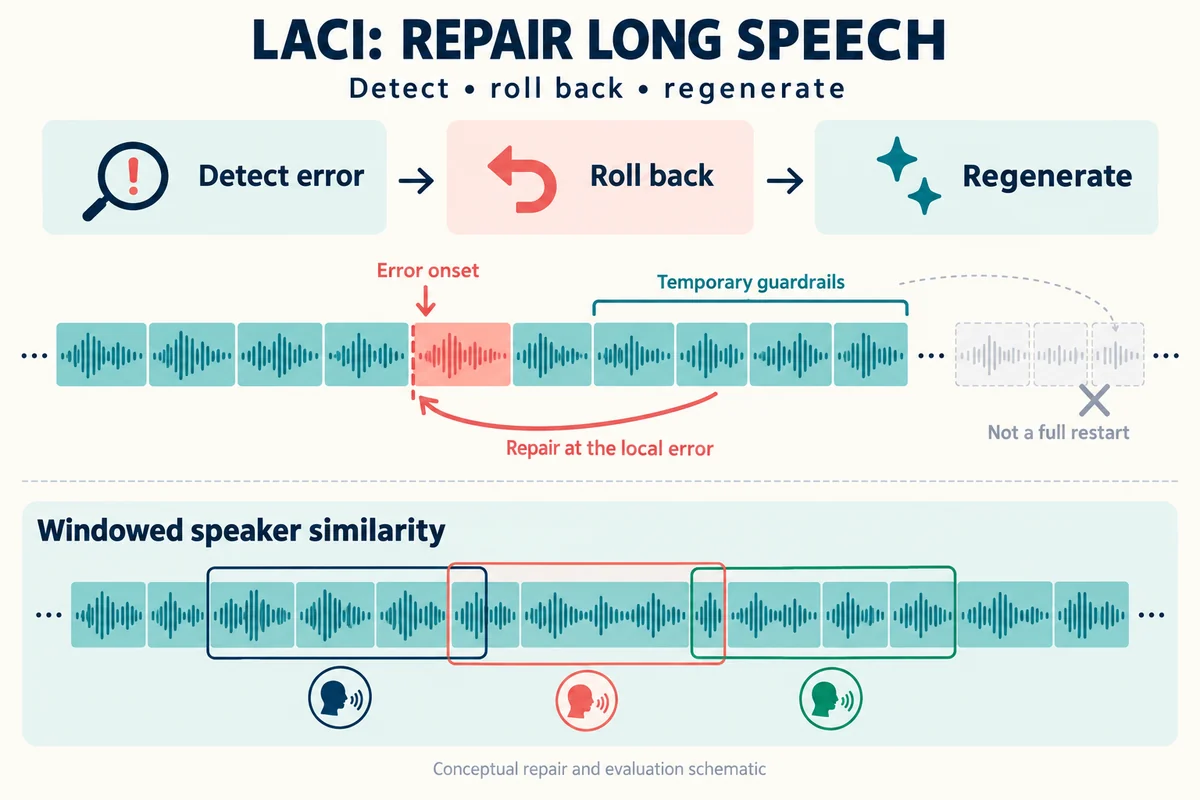
LACI studies a problem that short voice demos can conceal: a speech generator may work well for a sentence and fail during a long passage. Its proposed intervention detects an emerging error, returns to the affected point, and regenerates locally. The research is especially relevant when a small number of severe failures matters more than a good average score.
Research reviewed September 17, 2026.
What the September paper proposes
In the September 15, 2026 preprint Taming Long-form Text-to-Speech, Rongxiang Wang and colleagues introduce Localized Attention-Constrained Inference. LACI monitors text-audio attention, detects defined skipping or hallucination failures, and applies temporary constraints during recovery. The paper evaluates Qwen3-TTS variants and VoxCPM2 on call-center material, reporting improvements in long-form reliability. It also introduces windowed speaker similarity, wSIM, to expose local identity changes that a whole-recording comparison can obscure. Read the LACI paper.
The relevant distinction is local failure recovery inside a generation system. It is different from manually cutting a finished recording into chapters or applying an audio effect after export.
Why average quality can conceal a bad passage
Consider an original example: a ten-minute narration contains nine clear minutes and a minute with repeated or missing material. A listener who needs the omitted instructions cannot recover them from the quality of the other sections.
That makes the unit of evaluation important. A score for the whole recording can answer whether an output is broadly similar to a reference, but a production reviewer also needs to know where it becomes unusable.
Create an error timeline alongside overall measurements. Mark omissions, repetitions, unexpected additions, voice changes, and unfinished endings. Keep the timestamp and the corresponding text location.
The aim is not to replace summary metrics. It is to make their implications visible. A stable average combined with fewer severe local failures may be valuable even when the headline number moves only modestly.
Distinguish detection from recovery
An error-handling system has at least two separate jobs. It must identify a problem, and its repair must improve the result. A useful evaluation should score both.
For detection, inspect missed failures and false alarms. For recovery, compare the repaired passage with its original version, then listen across the repair boundary. A correct replacement can still create a noticeable change in rhythm or voice.
These are proposed review criteria rather than claims about LACI's observed defects. They help avoid a common shortcut: counting every triggered repair as a successful correction.
Keep a condition in which no error is present. A recovery method should preserve already acceptable speech. This gives a reviewer evidence about unnecessary intervention, not merely evidence that the system can improve a difficult example.
Test long text without changing every other variable
Prepare passages of different lengths from the same broad domain. Keep the vocabulary difficulty and voice reference as consistent as possible.
An illustrative design might compare one section, several connected sections, and a complete document. If the longest condition also introduces unfamiliar names and complex notation, a failure cannot be attributed to length alone.
Repeat generation under the same conditions when sampling is stochastic. Record the range of outcomes and retain the weaker runs. A single successful output demonstrates possibility, while repeated runs address reliability.
Use text that has been checked before synthesis. Our guide to recording and editing audiobook chapters offers a production context for long narration, but the research comparison should hold editing decisions steady across conditions.
Examine the voice across time
For a speaker-consistency review, sample the opening, middle, ending, and any region with a detected problem. Compare those excerpts to the same authorized reference.
Ask listeners whether the voice remains plausibly the same speaker and whether changes reflect ordinary expressive variation. An emotional shift should not automatically be treated as an identity failure.
If using an automatic windowed measure, document the window length and overlap. Small windows offer more precise localization but contain less speech evidence. Large windows contain more evidence but may dilute a brief anomaly. That is a general measurement tradeoff to investigate.
Do not compare windowed and whole-recording scores as though they have identical interpretations. Keep the time series, the aggregate summary, and a few reviewed examples together.
Count the cost of recovery
Measure extra generated audio, retry counts, total completion time, and playback interruptions. A local correction that saves a full regeneration may still affect a system with a tight playback buffer.
Distinguish research timing claims from your actual hardware and integration. If the listener hears audio while generation continues, evaluate whether a repair arrives before that passage is played.
Set a maximum retry policy for an experiment and record what happens when recovery does not succeed. That boundary makes results reproducible and prevents an unlimited search from looking like a single reliable attempt.
Also retain the unchanged baseline output. Without it, a reviewer cannot tell whether the repaired version improved the targeted passage or merely produced a different error.
Decide what evidence would justify adoption
A useful acceptance report contains complete audio, a text-aligned error timeline, repeated-run summaries, local voice checks, and recovery costs. Separate common minor imperfections from failures that make a passage unusable.
Our interpretation is that LACI's strongest research question concerns the tail of the outcome distribution: how bad can an ordinary generation attempt become, and can a targeted intervention prevent that outcome?
The current paper is recent evidence from defined models and data. It does not establish that the method applies unchanged to every architecture or language. Test those extensions explicitly.
For defects found after generation, the AI voice artifact guide addresses practical diagnosis. For research on long-form generation itself, LACI encourages a more demanding standard than a polished excerpt: preserve the full run, inspect its weakest region, and report the work needed to recover it.
Try Our Voice Clone Demo
Hear your words come to life
Choose a voice and try a short preview.
Listen to sample voices
Hear examples before choosing a voice. Generated results can vary with the script and reference sample.
Looking for another voice?
Explore the library and listen to a sample before you create.

Morgan Freeman

Stephen Hawking

Christiano Ronaldo

Donald Trump

Kokoro

Disney XD Announcer

Cute Japanese Girl
Vin

Adam Stone
Transform Your Content with AI Voice Technology Today
Try a short voice preview, then create speech and save your audio in a workspace built for your next project.
Generate Your Voice Now