
Qwen-Audio-3.0-TTS Research: Control and Robustness
Explore Qwen-Audio-3.0-TTS's five-stage training research, speech control, reference robustness, and practical evaluation ideas beyond a short clean demo.
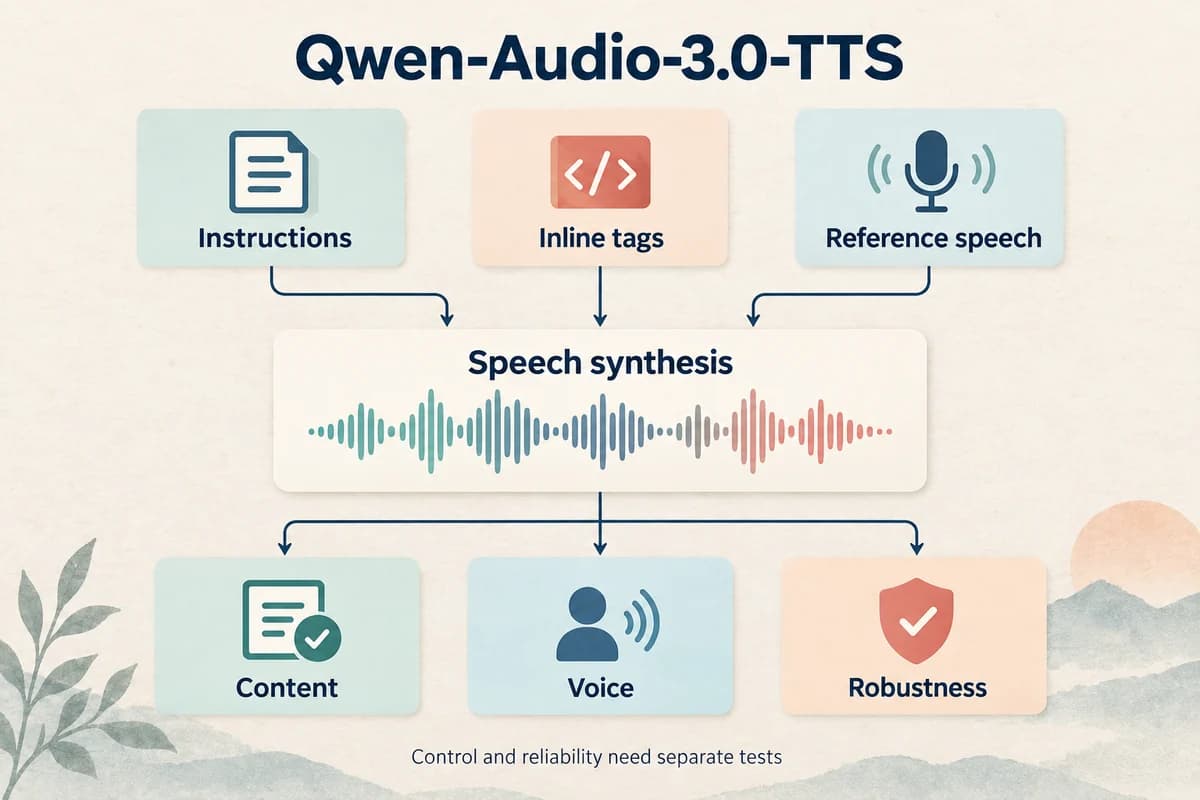
Qwen-Audio-3.0-TTS studies how speech synthesis can remain accurate and controllable under several demands at once. Its July 2026 report is particularly useful for thinking beyond a short, clean demonstration: difficult text, expressive direction, longer passages, and imperfect references all deserve evaluation.
Research reviewed September 17, 2026.
This article reviews the paper and its linked demonstration page. It does not reproduce the authors' experiments, announce downloadable weights, or imply that VocalCopyCat supports this system.
Keep the model identity precise
Qwen-Audio-3.0-TTS is the title of a report submitted on July 27, 2026. It should not be casually treated as another name for January's Qwen3-TTS release.
The report describes a 12.5 Hz speech tokenizer and a language-model/flow-matching system trained through five stages: separate pretraining, joint training, language-model reinforcement learning, acoustic robustness training, and flow-matching reinforcement learning. It reports support for sixteen languages and twenty Chinese dialect regions, plus one-pass synthesis up to three minutes. These are author-described capabilities. See the Qwen-Audio-3.0-TTS paper.
For a research comparison, use the full model name and paper date. That small habit prevents a result or feature from being transferred to a different checkpoint merely because the names look related.
Understand the reason for staged training
The paper connects the acoustic generator to continuous hidden states from the language model during joint training. Its later stages target different parts of the system, including content, acoustic resilience, and perceptual quality.
The practical interpretation is that a fluent result depends on several interacting abilities. Correct words, convincing identity, expressive phrasing, and clean sound are related, but one successful dimension does not establish the others.
A useful conceptual diagram lists the five training stages in order and places evaluation questions beneath them. The diagram should explain the research sequence, not imply that an end user manually runs these stages for every voice-over.
For a production team, the lesson is to create a similarly varied evaluation set. A single “overall quality” score can hide whether improvements in one area came with weaknesses elsewhere.
Test text that has several possible readings
Prepare a short script containing a date, a decimal, an acronym, and a product version. Write the intended spoken form beside each item before generation.
For example, an invented software tutorial might contain “version 3.2,” “12/04,” and “API.” Decide whether the date means April twelfth or December fourth in the target locale. Decide whether the acronym should be spoken as letters. The model cannot be fairly evaluated against an intention the reviewer never specified.
Use the numbers, dates, and acronyms guide to organize these decisions. Keep the audience-facing writing separate from any synthesis-specific expansion.
Listen without the script first, then compare against the intended reading. Record ambiguous input as an editorial issue and incorrect realization as a generation issue. That distinction makes the next revision more effective.
Evaluate expressive instructions without rewarding excess
The authors' demonstration page presents examples across the reported capabilities, including instruction-controlled speech. Treat selected demonstrations as illustrations, not as a representative failure-rate estimate.
Create a practical direction such as “explain this calmly to a first-time user.” Ask listeners whether the delivery serves that purpose. Do not simply ask whether they hear more emotion.
Compare a neutral instruction with one changed attribute. If a more enthusiastic direction also changes pronunciation or recognizable identity, record both effects.
For a longer passage, specify where the communicative purpose changes. A reassuring opening and a precise instruction may need different emphasis. Review whether the listener can follow that transition without the performance becoming theatrical or distracting.
Test reference robustness with authorized material
An imperfect reference can differ in room sound, background noise, microphone position, or clarity. These are distinct conditions and should be tested separately when practical.
Begin with a clean authorized recording and a fixed target script. Then use naturally available alternative recordings of the same speaker, documenting how they differ. Avoid changing the speaker, text, and recording condition simultaneously.
Ask reviewers to judge output intelligibility, identity, and unwanted sound character independently. A voice may remain recognizable while the recording's room-like quality becomes distracting.
Keep a clean reference as a comparison point. If the goal is resilience to ordinary field recordings, include those recordings in the pilot; if the project can obtain a new clean sample, assess whether that simpler preparation step solves the problem.
These are suggested experiments, not a claim that any degradation will be removed successfully.
Review a complete passage, including the ending
Longer-form generation needs more than a strong first sentence. Choose a passage with several paragraphs, a list, and a concluding instruction, within the documented limits of the implementation you can access.
Mark the expected order of ideas. Listen for skipped material, repeated phrases, changed names, abrupt pace shifts, and a premature ending. Check whether the final sentence completes the thought and leaves usable room for editing.
If the passage is intended for video or learning material, evaluate it with the visual context. A natural paragraph in isolation may still speak past a diagram change or rush through a key action.
Do not extrapolate from a three-minute example to unlimited narration. Larger projects need a chunking, review, and continuity workflow of their own.
Build evidence for the intended application
Create an evaluation sheet with separate columns for text realization, speaker identity, expressive suitability, sound quality, reference condition, and completion. Add timing only if responsiveness is part of the intended use.
Use the voice-over quality assurance checklist to review final artifacts consistently. Retain the input, original generation, and any edited export together.
Document whether each observation comes from the paper, a curated demonstration, or your own pilot. That keeps a compelling research result from becoming an unsupported operational promise.
Qwen-Audio-3.0-TTS is valuable reading because it treats speech generation as a collection of coupled requirements. The practical response is equally specific: test the difficult text, the requested performance, the reference conditions, and the complete passage that your listeners will actually encounter.
Try Our Voice Clone Demo
Hear your words come to life
Choose a voice and try a short preview.
Listen to sample voices
Hear examples before choosing a voice. Generated results can vary with the script and reference sample.
Looking for another voice?
Explore the library and listen to a sample before you create.

Morgan Freeman

Stephen Hawking

Christiano Ronaldo

Donald Trump

Kokoro

Disney XD Announcer

Cute Japanese Girl
Vin

Adam Stone
Transform Your Content with AI Voice Technology Today
Try a short voice preview, then create speech and save your audio in a workspace built for your next project.
Generate Your Voice Now