Chatterbox v3 Research: Languages and Audio Watermarks
Review Chatterbox Multilingual v3's language coverage, PerTh watermarking, and evaluation limits, with a practical plan for checking your exported audio.
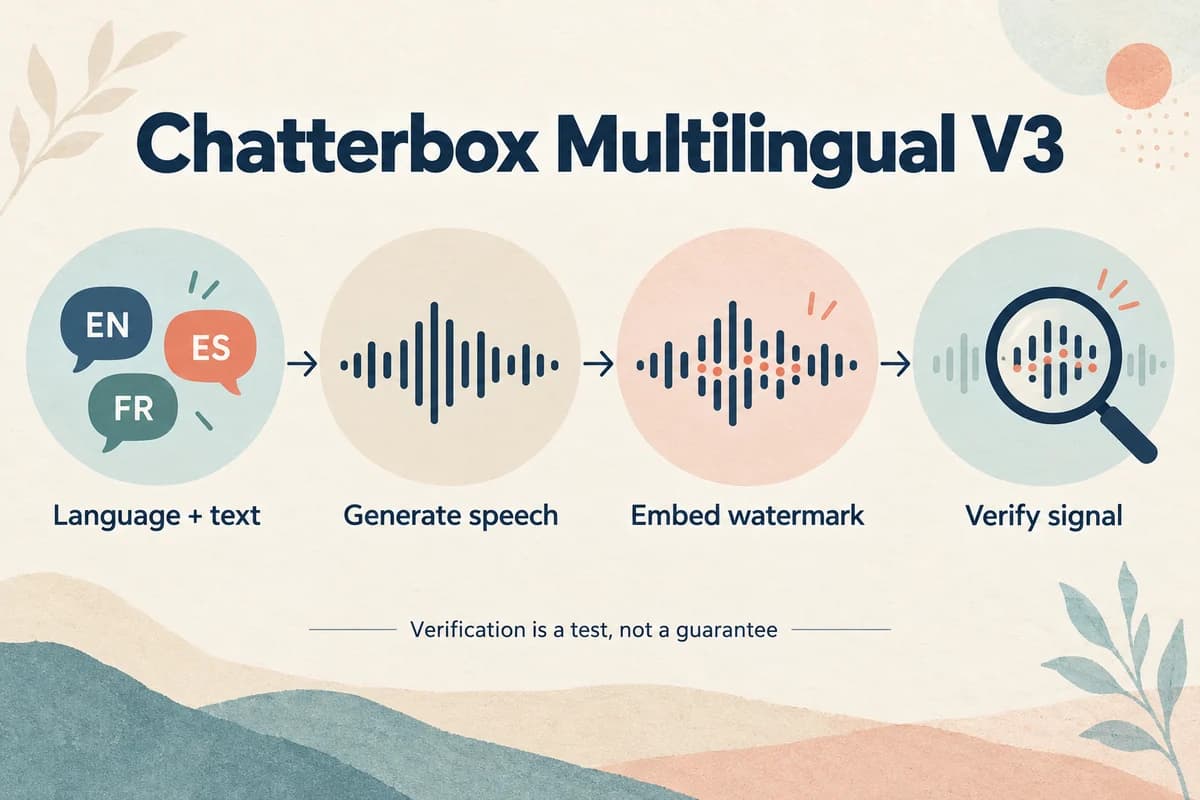
Chatterbox Multilingual v3 combines speech generation with a provenance feature: an embedded audio watermark. The two deserve separate evaluation. A voice can be clear while provenance checks fail somewhere in an export workflow, and a detectable watermark does not establish that the spoken content is correct.
Research reviewed September 17, 2026.
This review uses Resemble AI's release materials and repositories. It does not present independent listening results or watermark measurements, and it does not imply VocalCopyCat includes Chatterbox.
Read the language count with its definition
The June 10, 2026 announcement describes twenty-five total language and dialect entries, including four dialects and six dedicated language-pack models. It retains a 0.5-billion parameter Llama backbone. The release also describes PerTh watermarking as enabled by default on self-hosted outputs. See the official v3 announcement.
A count that includes regional variants and specialized checkpoints should not be read as twenty-five equally capable options inside one interchangeable model. Select the exact artifact that corresponds to your audience.
The official Chatterbox repository distinguishes the general multilingual model from dedicated language packs. Record that distinction in a trial. Comparing a specialized checkpoint with a general model can be useful, but the comparison needs an accurate label.
Understand what the watermark can establish
PerTh operates on audio rather than relying only on a filename or a descriptive metadata field. The official PerTh repository provides watermark embedding and extraction interfaces.
Think of the watermark as one observable property of an audio asset. It is not the script, the speaker's permission record, or a complete account of who handled the file.
The v3 announcement says its signal does not identify the model version or tenant. It also notes that systematic adversarial robustness curves had not been published. Therefore, describe detection results within the conditions actually tested rather than promising permanent identification.
A positive result should be recorded with the tool version and tested file. A negative result should trigger investigation of that workflow; it should not become proof that a recording was made by a human.
Test the files that audiences actually receive
Begin with a generated master and keep it unchanged. Create the normal delivery versions your workflow needs, such as a video export or compressed audio download.
Run the documented detection procedure on the master and each delivery file. Record the filename, format, duration, detector version, and returned result. Also retain the exact processing steps between the master and each export.
This is a compatibility check for your own publishing path, not an attempt to remove the watermark. The aim is to learn whether ordinary production operations preserve a usable signal.
If a result differs, reproduce the normal export one step at a time and document the point of change. Do not discard the original master while investigating. A small, traceable test is more useful than a broad claim that a watermark “works everywhere.”
Keep provenance and editorial approval separate
A production record should answer several different questions: what text was approved, which voice source was authorized, what generated the audio, and which file was published.
Store those answers explicitly. A detector output belongs in the same record, but it cannot replace the other fields.
Use the voice-cloning permission checklist when a real person's voice is involved. Keep the permitted purpose and source recording with the project. A watermark can travel with sound; the editorial responsibility for choosing that sound still needs an accountable workflow.
For a collaborative team, define who approves narration and who verifies exports. This prevents an automatically generated artifact from being mistaken for a finished, authorized asset merely because it carries a provenance signal.
Evaluate languages with listeners as well as transcripts
Resemble's v3 report uses a transcription-based character-error protocol and explicitly separates that from naturalness and speaker similarity. It also flags Korean and Vietnamese as unsuitable for production in that release. Those limitations are part of the evidence, not details to omit from a language list.
For your selected language, prepare a passage with names, numbers, an explanation, and a conversational sentence. Have a fluent reviewer identify uncertain words before revealing the script.
Then ask about regional pronunciation, appropriate emphasis, and recognizable voice identity. Keep these comments separate from transcription errors. A sentence can be transcribed correctly while sounding unsuitable for the audience.
The multilingual voice-over workflow helps keep translation, speech generation, and review distinct. Evaluate the target-language script itself before using it to judge a model.
Compare a general model and a language pack fairly
If both options cover your audience, use the same approved script, authorized voice reference, and review procedure. Record any input adjustments needed by each configuration.
Include a typical passage and a difficult passage. The typical passage represents daily work; the difficult passage reveals whether the system handles terminology and unusual punctuation gracefully.
Randomize listening order and retain several generations. Do not select one model's best take and another model's first take. Count retries and repair effort as part of the result.
Evaluate provenance on the exact deployment route used for each candidate. The announcement distinguishes self-hosted watermarking from other deployment arrangements, so do not assume a feature is enabled merely because the weights share a family name. Verify the actual output and applicable documentation.
Make the release decision auditable
A concise acceptance record can include the selected checkpoint, language variant, script set, listener findings, regeneration count, watermark checks, and export procedure. Attach the final approved files.
Define what happens when one area fails. A pronunciation issue may need text correction. An unsuitable regional delivery may require a different voice or checkpoint. An unexpected detection result may require an export review. These are different repair paths.
Do not collapse them into a single quality score. The team needs to know whether it is fixing communication, identity, or provenance.
Chatterbox v3 is a useful case study because its release discusses speech quality and watermarking together while acknowledging limits in both. A careful adoption decision should preserve that distinction: evaluate the listening experience, verify the delivery artifacts, and keep the editorial record complete.
Try Our Voice Clone Demo
Hear your words come to life
Choose a voice and try a short preview.
Listen to sample voices
Hear examples before choosing a voice. Generated results can vary with the script and reference sample.
Looking for another voice?
Explore the library and listen to a sample before you create.

Morgan Freeman

Stephen Hawking

Christiano Ronaldo

Donald Trump

Kokoro

Disney XD Announcer

Cute Japanese Girl
Vin

Adam Stone
Transform Your Content with AI Voice Technology Today
Try a short voice preview, then create speech and save your audio in a workspace built for your next project.
Generate Your Voice Now