
Confucius4-TTS Research: Cloning Without Transcripts
Learn how Confucius4-TTS uses speaker conditioning for transcript-free cloning, what its reported results cover, and how to evaluate cross-language identity.
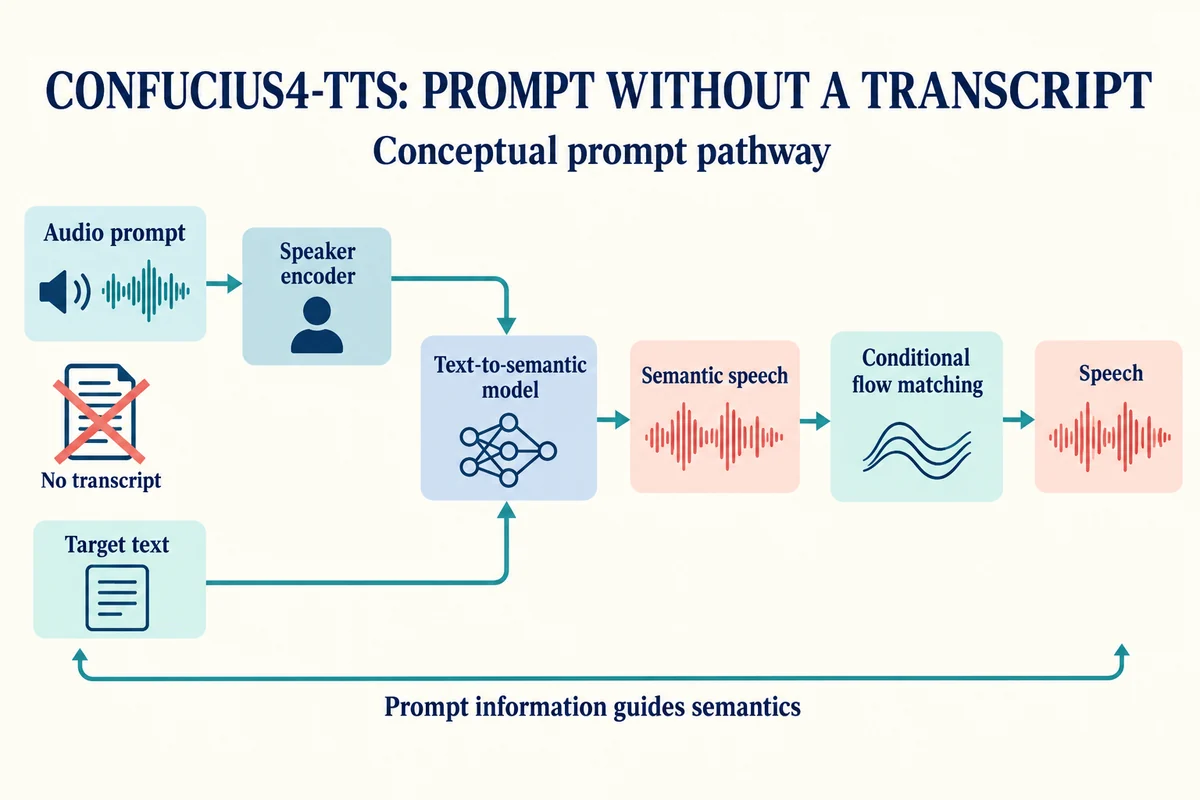
Confucius4-TTS studies a practical voice-cloning problem: using a reference recording without first providing a transcript of that recording. The target speech still comes from text. The research question is how to carry speaker identity from the reference into new speech, including speech in another language.
Research reviewed September 17, 2026.
The following discussion separates the authors' model description from an original evaluation plan. No results here represent independent testing, and this article does not announce a VocalCopyCat integration.
Understand what transcript-free means
The August 12, 2026 report describes a two-stage system covering fourteen languages. Its text-to-semantic module receives speaker information from a learnable encoder operating on self-supervised speech representations. A conditional flow-matching stage generates acoustic features. The authors also describe a continuation mode that can use a reference transcript. See the Confucius4-TTS paper.
The distinction is about the reference input. It does not mean the system invents a script, translates automatically, or understands the desired use of a person's voice.
Imagine having permission to use a clean recording in one language and an approved narration script in another. A transcript-free interface can remove one preparation step. The reference still needs to contain the intended speaker clearly, and the target script still needs editorial review.
Why learn speaker information for synthesis
The paper's speaker encoder is trained jointly with the text-to-semantic stage. The reported design aims to make its conditioning useful for generating speech, rather than simply importing a representation trained only to verify speaker identity. These are the authors' architectural choices; their value for a particular recording must be tested.
For an evaluator, the useful question is what information survives the reference-to-output transition. Does the generated speaker retain recognizable qualities across different words? Does a noisy or unusually expressive reference alter the result? Does the target language change the perceived identity?
Think of the reference as evidence about a speaker, not a command to reproduce every property of a recording. A distant microphone, room echo, or strong performance style may be undesirable in a new narration.
That interpretation suggests a reference selection experiment before any large production run.
Compare reference choices without changing everything
Prepare three authorized recordings of the same speaker: a neutral explanation, a conversational passage, and a more animated reading. Keep recording quality as similar as possible.
Generate the same short target script with each reference. Ask listeners to score recognizable identity and appropriate delivery separately. Then repeat with a longer script containing different sentence shapes.
This reveals whether your preferred reference supports the intended task or merely resembles a striking demo. Keep notes such as “identity remains recognizable, but every sentence sounds excited” instead of reducing the result to one number.
For new recordings, use the voice-cloning sample guide. If an existing clip contains multiple speakers, do not assume transcript-free conditioning will select the right person. Choose an unambiguous segment and retain a record of why it was selected.
These suggested comparisons do not establish a required reference length or guaranteed performance.
Distinguish reference cloning from continuation
The official project provides inference examples and separates reference-based use from continuation with reference text. Review the matching configuration in the Confucius4-TTS repository before comparing outputs.
For a fair mode comparison, use the same speaker, target text, and output review criteria. If one mode receives a transcript, document that extra input. Otherwise a performance difference can be misread as a model improvement when the input conditions changed.
Continuation may be attractive when extending an existing passage. Reference cloning may fit a separate new script. Do not select a mode purely because a sample sounds impressive; select the mode that matches the editorial relationship between the old recording and the new material.
Include the join in your listening test if the generated clip will follow the reference in a finished program. A voice can resemble the source yet reveal a conspicuous change in pace, room character, or sentence energy at the edit.
Build a cross-language identity review
Use a source-language listener familiar with the speaker and a fluent listener for the target language. Their judgments answer different questions.
The first listener can assess recognizable identity. The second can judge pronunciation, phrasing, and whether the target speech sounds appropriate. Neither judgment should automatically replace the other.
Choose scripts with an ordinary explanation, a proper name, and a short question. Avoid evaluating only greetings; a greeting provides little evidence about sustained narration. Have reviewers identify uncertain words before they see the script.
The multilingual voice-over workflow provides a useful structure for translation, generation, and review. Keep those stages visible. If a translation itself is unnatural, repeated generation may never solve the underlying problem.
Do not describe a voice as “native” based solely on identity similarity or an automated transcript. That conclusion requires the relevant listening evidence.
Read reported scores within their boundaries
The paper reports a 3.73% average word error rate across six directions on its CV3-Eval cross-lingual evaluation. It also reports human comparisons on an internal set. Those are author-reported results with specific test conditions, not a forecast for every language, accent, or reference clip.
A practical review should inspect the underlying error types. Missing a common article and changing a product name can have different consequences even if both affect a transcription metric.
Ask which language directions resemble your project and which do not. A source language may be well represented in one benchmark while your intended target language or regional variety receives little direct evidence.
Keep this uncertainty explicit in the decision record. “Promising architecture; pilot required for these two audiences” is a more useful conclusion than converting a benchmark average into a blanket quality promise.
Turn the paper into a reproducible pilot
Create a folder for each reference containing its permission record, original audio, target scripts, generation settings, and review notes. Assign outputs anonymous identifiers for listening.
Define acceptance conditions in ordinary language: all names correct, no omitted sentence, recognizable intended identity, suitable delivery, and no distracting sound changes. Add any requirements specific to a lesson, audiobook, or video.
Run enough varied material to expose a pattern, then stop and repair the pattern before generating an entire library. A short pilot with retained failures teaches more than a collection of carefully selected successful samples.
Confucius4-TTS is a useful research case because it treats speaker conditioning as a central design choice. For creators, the practical payoff is the possibility of simpler reference preparation. The evidence needed to adopt that workflow remains concrete: clear source audio, accurate target text, and listeners who can judge both the voice and the language.
Try Our Voice Clone Demo
Hear your words come to life
Choose a voice and try a short preview.
Listen to sample voices
Hear examples before choosing a voice. Generated results can vary with the script and reference sample.
Looking for another voice?
Explore the library and listen to a sample before you create.

Morgan Freeman

Stephen Hawking

Christiano Ronaldo

Donald Trump

Kokoro

Disney XD Announcer

Cute Japanese Girl
Vin

Adam Stone
Transform Your Content with AI Voice Technology Today
Try a short voice preview, then create speech and save your audio in a workspace built for your next project.
Generate Your Voice Now