
OmniVoice Research: What 600-Language TTS Means
Explore OmniVoice's multilingual diffusion design, distinguish language coverage from evaluated quality, and build a useful pilot for underserved audiences.
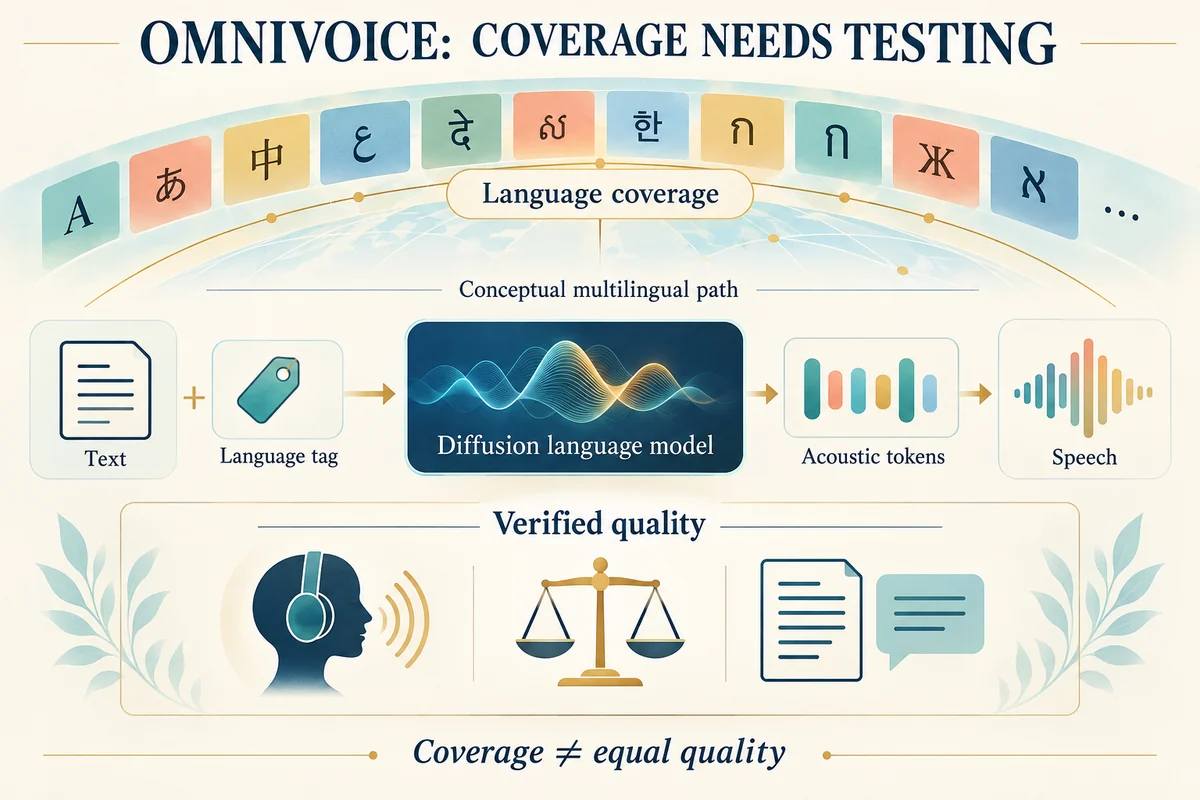
OmniVoice investigates how one zero-shot text-to-speech system can reach hundreds of languages. Its central idea combines a discrete diffusion-style model with direct text-to-acoustic generation, supported by a broad multilingual training collection. The language count is striking, but it is a starting point for evaluation rather than a universal quality guarantee.
Research reviewed September 17, 2026.
For an organization serving an underserved language, the most useful question is narrow: can the system produce accurate, culturally appropriate speech for this audience and this content? That question can be answered only with language-specific review and a clearly documented test.
Understand the model's direct route to speech
The April 1 OmniVoice paper describes a non-autoregressive discrete diffusion approach that maps text directly to multi-codebook acoustic tokens. It uses random masking across codebooks and initialization from a pretrained language model. The authors report a 581,000-hour collection spanning more than 600 languages.
Rather than interpreting the model as an ordinary left-to-right text generator that happens to emit sound, think of the speech representation as something progressively filled in. That difference motivates questions about parallel generation and context, but it does not establish an automatic advantage for every application.
A useful comparison must hold the intended task steady. A system designed to generate a complete passage efficiently and a system designed to begin speaking from incoming text may prioritize different behavior.
Separate supported languages from evaluated languages
The paper includes multilingual benchmarks covering 24 and 102 languages. Those evaluations do not establish the same level of evidence for every language in the broader training collection. The full paper identifies the datasets and evaluation procedures.
This distinction matters most where the headline is most attractive. A language that rarely appears in commercial tools may also have fewer resources for automatic assessment. An encouraging aggregate result can therefore tell you less about that particular audience than you initially expect.
Create three columns in a research note: reported support, published evaluation, and your own reviewed examples. Keep them separate. If a language is in the first column only, label its suitability as untested for your use rather than treating absence of negative evidence as approval.
Plan a pilot with speakers of the target language
Begin with a fluent reviewer who understands the intended audience. Ask them to help choose a small test set before generating audio. Otherwise, the test may overrepresent easy, formal sentences.
Include a greeting, an instruction, a question, a short explanation, and a passage containing names or locally familiar terms. Where appropriate, include different sentence lengths and an example of the writing conventions the actual project uses.
For a community information guide, a successful greeting is insufficient if the address or action step is wrong. Ask the reviewer to identify errors that change meaning, errors that sound unnatural, and acceptable regional variants.
The multilingual production guide helps organize approvals. For an exploratory model pilot, add a confidence field so reviewers can distinguish clear failures from uncertain or context-dependent judgments.
Treat the text frontend as part of the system
The official OmniVoice repository provides inference examples and documents controls including phonetic handling for particular languages. Do not infer that a control demonstrated for one writing system works identically for every supported language.
Your test begins before the acoustic model. Check the input encoding, punctuation, language selection, and any preprocessing used by the implementation. A number or abbreviation may need a deliberate spoken form.
Suppose a guide contains a local place name beside a date. First approve how that phrase should be spoken. Then test the ordinary text. Only introduce a supported override when you can describe the intended correction precisely.
Record the readable source separately from any synthesis-specific text. The script translation guide explains why natural spoken phrasing and written display text may need different treatment.
Ask whether the cloned voice travels well
Cross-language identity is not simply a similarity score. A listener may recognize aspects of a voice while finding its rhythm or pronunciation inappropriate for the target language.
Use a consenting speaker reference and evaluate identity separately from target-language fluency. Ideally, include a reviewer familiar with the source voice and another qualified to assess the target language. One person may not be equipped to answer both questions.
A proposed comparison can hold the target text fixed while changing only the reference. Does one reference encourage unwanted source-language pronunciation? Does the voice remain consistent across short and longer passages? Are names handled reliably?
Do not interpret a language mismatch as a defect in the speaker. It is a system behavior to characterize. The result may still suit one creative task while failing an informational guide where clarity is essential.
Evaluate the whole release process
A language pilot should include the final listening format. Test the audio after captions, music, compression, or video editing are added. An error that was noticeable in a clean audition can become harder to catch in a busy mix.
Keep a record of the time needed for human review and corrections. Broad model coverage can reduce one access barrier while leaving substantial editorial work. That is an important result, not an embarrassment to hide.
Use a simple status for each segment: accepted, revise text, regenerate, or unsuitable. Add a short reason. This makes it possible to see whether failures cluster around numbers, named entities, long sentences, or a particular delivery style.
Avoid presenting a small pilot as a language-wide benchmark. Describe the material, reviewers, and conditions that support the conclusion.
Use the breadth as an invitation to investigate
OmniVoice’s broad scope is especially valuable when it creates a credible option where few existed. The right response is neither to dismiss the language count nor to assume uniform readiness.
Choose a limited application, involve qualified reviewers, and publish only the segments that meet the project’s requirements. Preserve the checkpoint and implementation details so future updates can be compared against the same corpus.
A useful conclusion might be that a particular version handles short informational passages well but needs manual treatment of local names. Another may be that the available output is not yet suitable for the target audience.
Both conclusions are more informative than a generic claim about hundreds of languages. The research opens a large space of possibilities; careful local evaluation determines which of those possibilities is useful today.
Try Our Voice Clone Demo
Hear your words come to life
Choose a voice and try a short preview.
Listen to sample voices
Hear examples before choosing a voice. Generated results can vary with the script and reference sample.
Looking for another voice?
Explore the library and listen to a sample before you create.

Morgan Freeman

Stephen Hawking

Christiano Ronaldo

Donald Trump

Kokoro

Disney XD Announcer

Cute Japanese Girl
Vin

Adam Stone
Transform Your Content with AI Voice Technology Today
Try a short voice preview, then create speech and save your audio in a workspace built for your next project.
Generate Your Voice Now