
How to Translate Scripts for Natural Voice-Over
Translate voice-over scripts for meaning, timing, and natural delivery. Use a practical brief, terminology sheet, read-aloud review, and clear revision process.
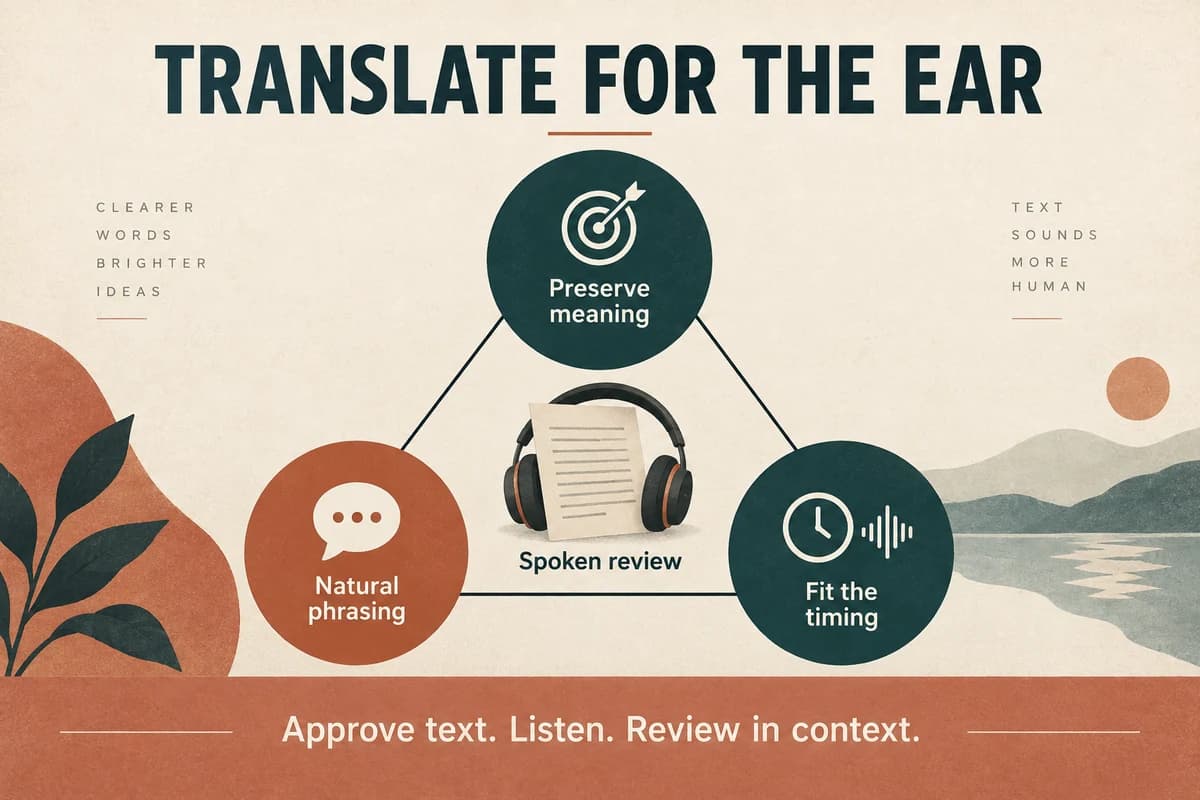
Translate a voice-over script by preserving its purpose and meaning, then adapting its phrasing for the target audience and the available time. Approve the written translation, hear a spoken sample, and review the final audio with its visuals before release.
A word-for-word translation can preserve vocabulary while losing the instruction, joke, emphasis, or tone that made the source useful. A good brief tells the translator which elements must stay exact and where natural phrasing is more important than matching sentence structure.
Explain what every line is trying to do
Give the translator the full script and the context around each segment. Include screenshots or a rough video when the words refer to something on screen.
Mark lines by function: introduce a topic, explain a step, identify a button, reassure the listener, or ask for an action. This helps the translator preserve the intended effect.
For a fictional app tutorial, “You're all set” could mean that setup has finished. In another context it could mean that an account is ready for a future action. The translator needs to know which state the product actually reached.
Include the audience and locale in the brief. A tutorial for experienced operators may use terminology that would be confusing in a first-use guide for customers.
Give one person authority to resolve source ambiguity. Translators should not have to guess whether a confusing sentence reflects the product or a drafting mistake.
Separate fixed terms from adaptable language
Prepare a terminology sheet with product names, interface labels, approved technical terms, units, and phrases that must retain a specific meaning.
A useful entry includes the source term, definition, approved local wording, usage example, and reviewer. Add a note when a brand name should remain unchanged.
Do not freeze ordinary connective language unnecessarily. The translator needs room to build natural sentences around fixed terms.
Also inspect numbers, dates, currency, and examples. Localization can involve regional conventions beyond the language itself, as W3C explains in its localization overview.
For example, a date written as “04/05” can be ambiguous to an international audience. Clarify the intended date in the source brief, then use a locally appropriate spoken form. The right result begins with unambiguous source information.
Adapt idioms and references deliberately
Identify metaphors, jokes, sports references, and phrases whose meaning depends on shared cultural knowledge. Explain their intended message to the translator.
“Let's hit the ground running” may simply mean “Let's start with the first practical step.” If the flourish adds little, simplifying the source can improve every language version.
For a promotional line, list the non-negotiable promise and the desired tone. Let the translator propose a natural version, then have the brand or product owner confirm that the claim has not become stronger.
Do not insert unsupported local claims to make the script sound familiar. A localized example should still be accurate for the product and audience.
Keep a note when an example changes. If a fictional training scenario uses a local holiday or workplace custom, the reviewer should understand the substitution and verify that it fits the intended learners.
Solve timing with editing choices
Measure a spoken draft before deciding that a translation is too long. Written length is only a rough proxy for performance time.
If a line overruns the scene, use this order of decisions:
- Remove redundant wording while preserving meaning.
- Split a dense instruction into two scenes.
- Extend or re-edit the visual if the project allows it.
- Ask for a shorter approved phrasing.
- Reassess delivery pace without making the speech difficult to follow.
Avoid solving every timing problem by accelerating the audio. A tutorial must give listeners time to connect the words with the action.
For planning, use a representative sample in the target language and calculate the pace from that sample. The voice-over timing guide shows a simple method. Do not apply an English word-rate assumption automatically to every language.
Review text and speech separately
Have a qualified reviewer check the translated script for meaning and terminology. Then have them listen to the generated or recorded version.
The audio review should cover pronunciation, word boundaries, stress, numbers, and pauses. Ask the reviewer to mark the exact segment and explain the desired correction. “Sounds odd” is hard to act on; “the product name is stressed on the wrong syllable” is more useful.
When a generator needs an altered input spelling to produce the intended pronunciation, preserve the standard spelling in the published transcript and captions. Store the alternate spoken input as a production note.
Back-translation can help reveal a meaning mismatch, but it is not a complete substitute for listening in the target language. A grammatically sensible translation may still feel unnatural or poorly matched to the visual timing.
Review the final media after corrections so the approved script and the released audio remain connected.
Keep a clear record of changes
Use stable segment IDs and record every approved revision. A row might include source revision, translated text, pronunciation note, audio filename, reviewer, and status.
When someone changes the source sentence, explain what changed in meaning. The target-language reviewer can then decide whether the existing translation remains valid.
For a release with several locales, follow the multilingual voice-over workflow. It gives translation, narration, and media review their own completion states.
Before delivery, check that the captions match the final speech, interface labels agree with the product, the call to action leads to a usable destination, and the correct language file is attached to the published version.
If you use VocalCopyCat for a supported narration task, start with a representative translated sample. The best time to discover a terminology or timing problem is before the same decision appears in twenty finished scenes.
Try Our Voice Clone Demo
Hear your words come to life
Choose a voice and try a short preview.
Listen to sample voices
Hear examples before choosing a voice. Generated results can vary with the script and reference sample.
Looking for another voice?
Explore the library and listen to a sample before you create.

Morgan Freeman

Stephen Hawking

Christiano Ronaldo

Donald Trump

Kokoro

Disney XD Announcer

Cute Japanese Girl
Vin

Adam Stone
Transform Your Content with AI Voice Technology Today
Try a short voice preview, then create speech and save your audio in a workspace built for your next project.
Generate Your Voice Now