
RVCBench: Evaluating Voice Cloning Under Stress
Learn what RVCBench tests across voice-cloning inputs, generation, and output handling, and design robustness checks that reflect real workloads.
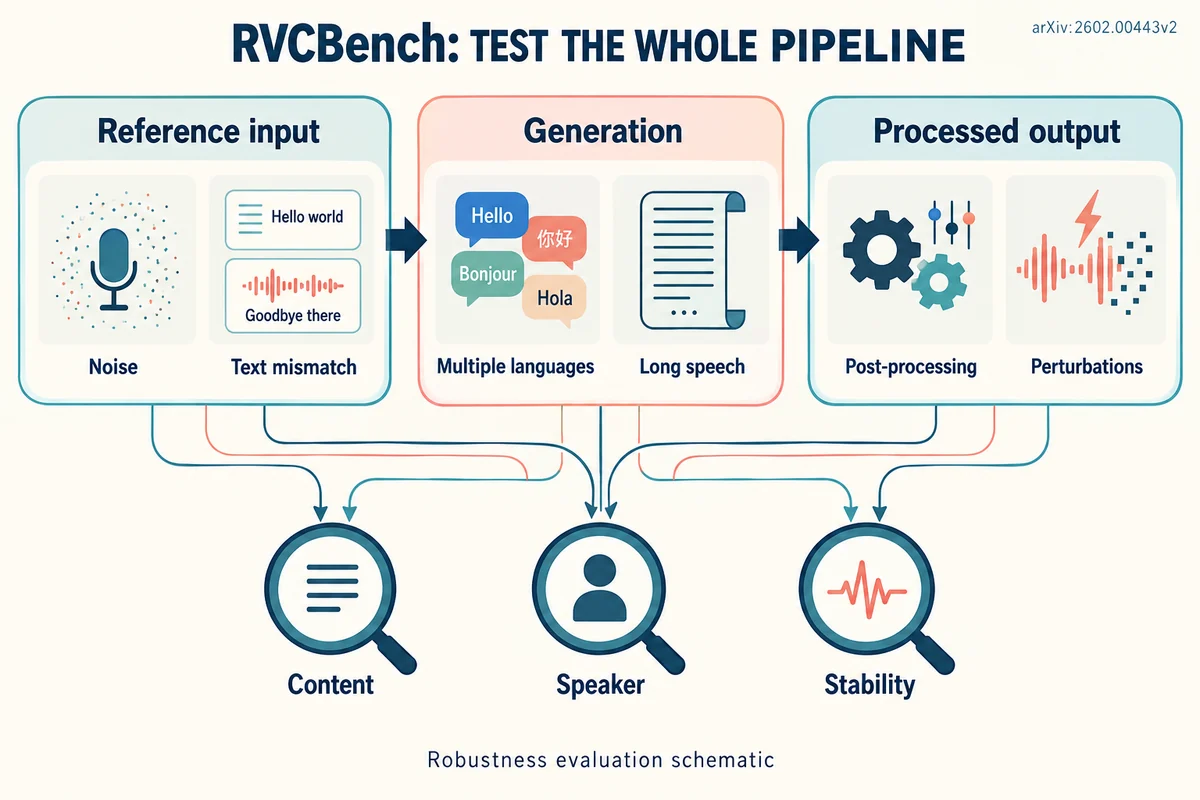
RVCBench asks whether voice cloning remains useful when its inputs and operating conditions change. A system that performs well on a clean, short demonstration may still need separate testing with imperfect references, longer text, other languages, and the audio files users actually receive. Robustness is therefore a collection of questions across a pipeline.
Research reviewed September 17, 2026.
What RVCBench brings to evaluation
Ruinan Jin and colleagues first submitted RVCBench on January 31, 2026, with the reviewed revision dated May 24. The benchmark evaluates voice cloning across input, generation, output, and audio-perturbation conditions. Its reported study covers 18 models and measures properties including content accuracy, speaker similarity, perceptual quality, and generation efficiency. The authors identify weaknesses that differ across these conditions. Read RVCBench.
For this article, the practical focus is ordinary reliability evaluation using authorized audio. The benchmark's broader security experiments do not need to be reproduced to learn from its pipeline-based approach.
Define what must remain stable
Start with a statement of intended behavior. An original example might be: “When a creator supplies a usable reference recording, the system should read the approved script intelligibly in a consistent voice.”
That statement contains several properties. The words must be correct. The voice must remain recognizable. The output must be usable in the delivery format. None should be silently substituted for another.
Create separate acceptance columns for content, identity, continuity, and delivery. A recording can preserve the speaker well while omitting a sentence. Another can contain every word but introduce distracting changes in pronunciation or rhythm.
Keep the acceptance criteria tied to the application. A brief notification and a long narrated guide have different failure costs, even when produced by the same model.
Build paired input conditions
Choose a clean reference as a baseline. Compare it with naturally occurring alternatives that resemble the recordings people submit, such as a room recording or a reference made on another device.
Use the same target text for each pair. If both the reference and script change, it becomes difficult to identify the cause of a difference.
Record what changed in the reference: its duration, recording environment, microphone distance, or presence of another speaker. Do not reduce all variation to a vague “bad audio” category.
The voice cloning sample guide explains how to create a strong starting reference. In a robustness experiment, that strong reference is a control condition against which realistic alternatives can be compared.
Add generation challenges one at a time
Prepare text sets for ordinary prose, unfamiliar proper nouns, longer passages, and any target languages relevant to the project. Keep their intended spoken forms available to reviewers.
Begin with isolated changes. Compare short and long text within one domain before mixing length, language, and unusual terminology in the same request.
After understanding individual effects, test combinations that occur in the actual workload. For example, a multilingual tutorial may naturally contain both longer instructions and product names. That combined case matters even if the isolated tests looked good.
Label every generated file with the model version, reference identifier, script identifier, and condition. A robustness result is only useful if the team can reproduce the example that caused concern.
Check the file the listener receives
Save the original generation and the final delivered file. Listen to both through the intended playback path.
If an application converts formats or changes loudness, treat that as a separate stage. Compare the processed version against its own original rather than against another model's unrelated output.
For an illustrative experiment, a team might discover that a source file sounds acceptable locally while the file attached to a published page has a truncated ending. That would be a delivery failure, not evidence about the generator's speaker modeling.
Our WAV versus MP3 guide explains practical format considerations. A benchmark should document the exact export path so that file handling does not become an invisible variable.
Report degradation as well as absolute quality
A model that begins with a strong baseline may still experience a large decline under one condition. Another may start lower but change less. Both the starting point and the change matter.
Keep condition-by-condition results instead of publishing only an overall average. Include the number of samples, representative failures, and uncertainty from repeated runs or listener disagreement.
Avoid declaring a universal winner from a workload that covers only a few speakers or one language. A useful report can make a narrower claim: within these references, scripts, and delivery conditions, one system remained more consistent.
Also distinguish missing coverage from success. If a model does not support a required condition, mark it as unsupported rather than awarding a zero or pretending the condition was tested.
Turn failures into an engineering priority list
For every material problem, record the stage where it first appears, its user impact, and the smallest reproducible example. This connects evaluation to action.
An input-related issue might call for clearer recording guidance. A generation issue might require a different model or text preparation. A delivery issue might require changing the export pipeline. These are possible responses, not guarantees that any one intervention will solve a failure.
Retest the failing condition after a change, along with a small set of previously successful controls. This checks whether the fix improves the targeted case without degrading ordinary requests.
RVCBench's research value is the discipline of examining voice cloning across changing conditions. Our practical recommendation is to preserve that structure: start with a clean baseline, vary one factor, inspect the complete pipeline, and keep a visible record of where quality stops meeting the intended use.
Try Our Voice Clone Demo
Hear your words come to life
Choose a voice and try a short preview.
Listen to sample voices
Hear examples before choosing a voice. Generated results can vary with the script and reference sample.
Looking for another voice?
Explore the library and listen to a sample before you create.

Morgan Freeman

Stephen Hawking

Christiano Ronaldo

Donald Trump

Kokoro

Disney XD Announcer

Cute Japanese Girl
Vin

Adam Stone
Transform Your Content with AI Voice Technology Today
Try a short voice preview, then create speech and save your audio in a workspace built for your next project.
Generate Your Voice Now