
S5-TTS: Streaming Speech With Limited Lookahead
Explore S5-TTS research on incremental speech, limited lookahead, and latency tradeoffs, with a practical plan for evaluating streaming voice systems.
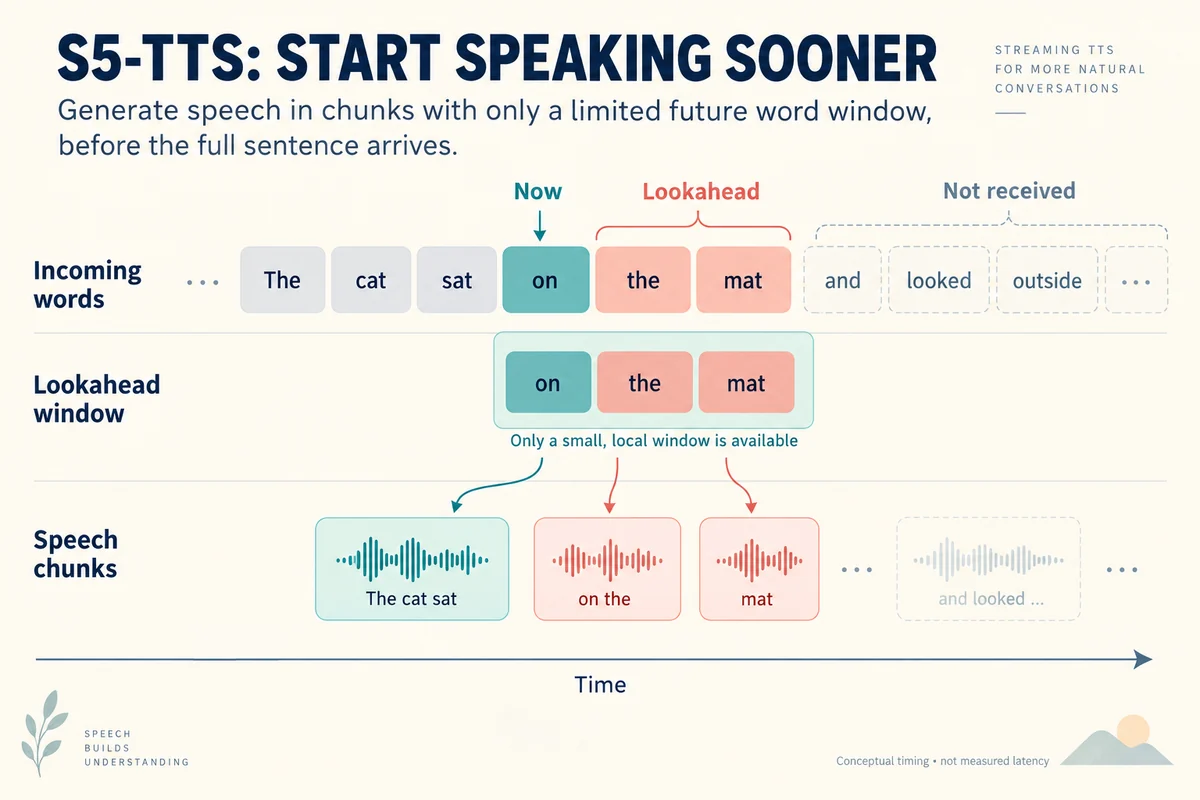
S5-TTS investigates how a speech generator can begin talking before all its text has arrived. The useful question is how much future text a system needs to produce a coherent opening without making listeners wait. Evaluating that tradeoff requires measuring the arrival of text, the start of playable audio, and the quality of the complete response.
Research reviewed September 17, 2026.
What the S5-TTS paper contributes
Muyang Du, Jason Roche, and Junjie Lai introduced S5-TTS in a June 20, 2026 paper listed for Interspeech 2026. Their model extends T5-TTS for incremental synthesis using monotonic alignment, a lookahead-causal mask, convolution-based auxiliary attention, and interleaved distillation. The authors report quality comparable to their full-context baseline alongside reduced response latency. Those results belong to the paper's experimental setup, rather than establishing a universal latency figure for every deployment. Read the S5-TTS paper.
The distinction worth investigating is access to future words. A generator that receives a complete paragraph has different information from one receiving an unfinished response. A fair comparison should make that information difference visible.
Why the next words can change the current phrase
Consider two original examples: “The package arrived, although the label was missing” and “The package arrived?” The opening words are similar, but a narrator who knows the continuation may choose different phrasing. This is an illustration of the evaluation problem, not a reported S5-TTS test.
Now imagine text arriving in small bursts. A system can wait for more context, commit to an interpretation, or produce conservative phrasing that leaves room for the continuation. Each choice has a different listener experience.
Build a test set containing ordinary statements, questions, interruptions, corrections, lists, and sentences with late clarifications. Include natural examples from the intended application. An assistant that mostly reads complete help articles has a different workload from one speaking while another model composes its answer.
Measure the entire path to audible speech
A useful timing record has several separate events:
- The application begins requesting a response.
- The first text becomes available to the speech component.
- Enough text is available for synthesis to begin.
- The first usable audio reaches the player.
- The listener hears the first spoken word.
- The final audio finishes arriving.
These are proposed instrumentation points. They prevent a fast model-only measurement from hiding waiting elsewhere in the application.
For an illustrative request, an audio component might start quickly after receiving text while the upstream writer has already consumed most of the user's waiting time. Conversely, a model may generate promptly but leave playback waiting for a large buffer. Both situations deserve attention, but they require different fixes.
Report the clock origin whenever quoting latency. “First audio” and “first audible word” should not silently become interchangeable.
Compare lookahead settings under equal conditions
A controlled experiment should keep the text, reference voice, hardware, and audio handling consistent while changing only the amount of future text available. Use the model's supported controls; do not assume an arbitrary interface exposes its internal lookahead mechanism.
Run both a predictable text stream and an uneven one. The predictable stream helps isolate synthesis behavior. The uneven stream represents the integration challenge of text arriving in bursts.
Keep complete transcripts and generated audio for every condition. Compare several requests, including longer ones, rather than choosing the example with the quickest opening. Record repeated runs where the implementation is stochastic.
If one setting appears faster, inspect whether it starts with meaningful speech or merely produces a longer lead-in. Also check whether later pauses make the conversation feel slower despite the earlier start.
Listen for costs that a speed metric misses
Use separate listening questions for initial phrasing, continuity, pronunciation, speaker consistency, and overall preference. A single “Which is better?” question cannot explain why a streaming configuration fails.
Ask reviewers to mark specific moments: an unnecessary pause before a noun, an opening that sounds like a complete sentence too soon, a question delivered as a statement, or a sudden change in emphasis. These are hypothetical failure categories for your test, not claims that S5-TTS exhibits each one.
Review clips without revealing which configuration is supposed to be faster. Then let reviewers experience the entire interaction with the real waiting time included. Audio-only judgments and interactive judgments answer different questions.
For a practical foundation in listening checks, use the existing voice-over quality assurance checklist.
Interpret the research without overextending it
The paper's comparison is evidence about a particular model and training setup. It does not show that every full-context generator can gain the same behavior through an application-level switch.
The central inference is broader: streaming evaluation should account for what information the system had when it committed to sound. A generated sentence can be accurate after all text arrives yet still be poorly suited to incremental delivery.
Keep language, sentence length, reference quality, and text arrival patterns in the report. If testing only clean English statements, describe that scope explicitly. Expand the experiment before making claims about multilingual dialogue, emotional acting, or long narration.
Also separate feasibility from integration readiness. A research method can be promising while requiring engineering work before it fits a particular application.
Turn the experiment into a decision
Create one review row per configuration with fields for text arrival pattern, startup delay, playback interruptions, pronunciation errors, listener comments, and completion time. Retain a representative failure alongside the successful examples.
Set acceptance criteria before comparing outputs. An example criterion might require an intelligible opening, uninterrupted playback under the expected connection conditions, and no material increase in pronunciation errors. The thresholds should come from the application's needs, not an invented industry standard.
For prepared narration, improving the script may be more valuable than reducing initial waiting. Our guide to punctuation for text to speech addresses that separate task. For interactive speech research, S5-TTS makes a more specific contribution: a testable approach to speaking with incomplete context, which should be judged as part of an actual conversation.
Try Our Voice Clone Demo
Hear your words come to life
Choose a voice and try a short preview.
Listen to sample voices
Hear examples before choosing a voice. Generated results can vary with the script and reference sample.
Looking for another voice?
Explore the library and listen to a sample before you create.

Morgan Freeman

Stephen Hawking

Christiano Ronaldo

Donald Trump

Kokoro

Disney XD Announcer

Cute Japanese Girl
Vin

Adam Stone
Transform Your Content with AI Voice Technology Today
Try a short voice preview, then create speech and save your audio in a workspace built for your next project.
Generate Your Voice Now