VoiceTTA: Adapting Speech Style During Generation
Understand VoiceTTA's test-time speech adaptation, its style and intelligibility tradeoffs, and how to evaluate improvements without reward bias.
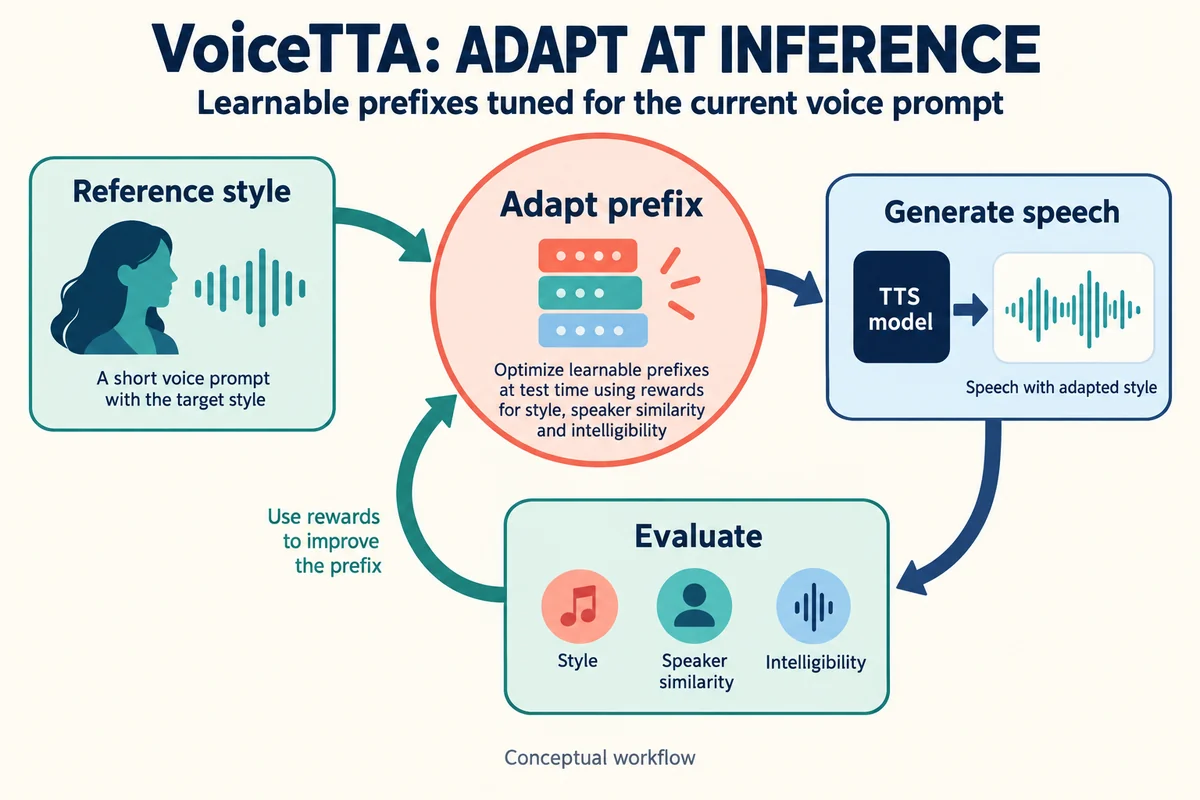
VoiceTTA explores adapting a pretrained speech generator to an unfamiliar reference style during use. Its practical significance is the possibility of improving style imitation without building a new model for every speaker. The difficult evaluation question is whether adaptation captures the intended delivery while retaining the correct words and a recognizable voice.
Research reviewed September 17, 2026.
What the VoiceTTA paper actually changes
Tianxin Xie and colleagues submitted VoiceTTA on June 25, 2026; the paper is listed as accepted to Interspeech 2026. The method optimizes learnable prefixes in a flow-matching TTS model at test time. Its rewards combine variation in pitch and energy with speaker similarity and a Whisper-based intelligibility measure. The reported experiments focus on uncommon prompts and show a tradeoff between style objectives and intelligibility when rewards are removed. Read the VoiceTTA paper.
This is research on adaptation inside a synthesis system. It should not be interpreted as a feature available in every voice application, or as a promise that any short recording can be imitated faithfully.
Separate voice identity from delivery
An original example helps clarify the task. Suppose the same speaker records a calm explanation and an animated sports introduction. A useful system might preserve recognizable vocal identity while changing rhythm and expressive emphasis.
A speaker-similarity score alone cannot settle whether the animated version sounds appropriately animated. Likewise, matching broad pitch variation does not demonstrate that emphasis falls on the right words.
Before testing adaptation, write down which properties should stay stable and which should change. “Same speaker, more energetic delivery” is a better starting point than “sound more similar.” Add a sentence explaining the intended situation: welcoming an audience, reading a technical explanation, or performing dialogue.
The existing guide to choosing an AI voice for your brand can help formulate a consistent listening brief.
Why several rewards need independent checks
A reward is a measurement used to guide optimization. If a system is rewarded for a property, improvement on that same measurement is useful evidence of optimization, but incomplete evidence of listener benefit.
Imagine an evaluator that prefers larger pitch variation. A generated sentence could increase variation in the wrong place. Or imagine an intelligibility score that improves while the voice becomes less expressive. These are general examples of competing objectives, not additional VoiceTTA findings.
A practical evaluation should therefore keep a separate panel of judgments. Ask whether the intended words are present, whether the target style is recognizable, whether the speaker identity remains plausible, and whether the performance is appropriate.
Treat disagreement between these judgments as information. Averaging everything immediately can hide a result that becomes more expressive at the cost of omitted words.
Design a reference-style experiment
Choose consented recordings from several speakers and more than one speaking situation. For each speaker, select a reference and prepare new target sentences that were not spoken in that reference.
Create a baseline using the unadapted system and an adapted condition using the same underlying generation settings. If the implementation permits repeated sampling, retain multiple outputs from both conditions.
Keep the evaluation text independent of the adaptation text. This matters because a method that reproduces one familiar phrase may not transfer its style to a different sentence structure.
Include a neutral target sentence alongside expressive material. A phrase such as “The folder contains the final three recordings” gives listeners fewer semantic clues about emotion than an explicitly celebratory line. This makes it easier to assess what the sound contributes.
Evaluate transfer rather than memorization
Organize the test around three distances: a new sentence in the same situation, a different situation from the same speaker, and a reference whose style is unfamiliar to the system.
These are proposed evaluation conditions, not categories copied from the paper. They help distinguish a narrow adaptation from a more reusable one.
For each condition, review errors separately. Did pronunciation change? Did the voice become exaggerated? Was a distinctive rhythm preserved even when the sentence became longer? Did the adaptation still help when the target text contained a question?
Maintain the reference recording and its transcript as distinct artifacts. The voice cloning sample guide explains how to prepare usable reference audio, but a clean reference does not replace this transfer test.
Account for adaptation cost
Measure the time spent adapting separately from the time spent generating the final sentence. Also report whether an adapted representation is reused for later requests.
An illustrative workload with one short sentence per speaker has different economics from a workload with many paragraphs per speaker. Even if the adaptation procedure is identical, its cost is distributed differently.
Track memory use, stored adaptation artifacts, and the conditions under which they need to be rebuilt. Avoid describing small parameter storage as equivalent to negligible total computation. A compact saved representation can still require meaningful work to produce.
For an engineering decision, compare total work across the intended workload. A method that improves a reference-specific style may be worthwhile for planned narration while being less suitable for an interaction with a strict startup deadline.
Read positive results with the right boundaries
The paper supports investigating adaptation as a way to improve difficult style matching. It does not establish that all uncommon accents, emotions, recording conditions, or speaking rates will benefit equally.
Our interpretation is that the method's most valuable test is a transfer test with independent listeners and independent text. The question is not merely whether the training objective moved in the intended direction.
Document negative and neutral outcomes. If the baseline already handles a reference well, adaptation might offer little practical benefit. If a reference is noisy or ambiguous, extra optimization may not resolve what the desired style actually is.
A useful final report contains paired audio, a short style brief, the adaptation time, intelligibility checks, and examples where listeners disagreed. That makes VoiceTTA's idea reviewable as a specific research intervention rather than a general claim that more adaptation always produces better speech.
Try Our Voice Clone Demo
Hear your words come to life
Choose a voice and try a short preview.
Listen to sample voices
Hear examples before choosing a voice. Generated results can vary with the script and reference sample.
Looking for another voice?
Explore the library and listen to a sample before you create.

Morgan Freeman

Stephen Hawking

Christiano Ronaldo

Donald Trump

Kokoro

Disney XD Announcer

Cute Japanese Girl
Vin

Adam Stone
Transform Your Content with AI Voice Technology Today
Try a short voice preview, then create speech and save your audio in a workspace built for your next project.
Generate Your Voice Now