
VoiceMOS 2026: What Speech Quality Scores Measure
Read VoiceMOS 2026 through its speech, emotion, and accent evaluation tracks, and learn how to validate automatic quality scores against listeners.
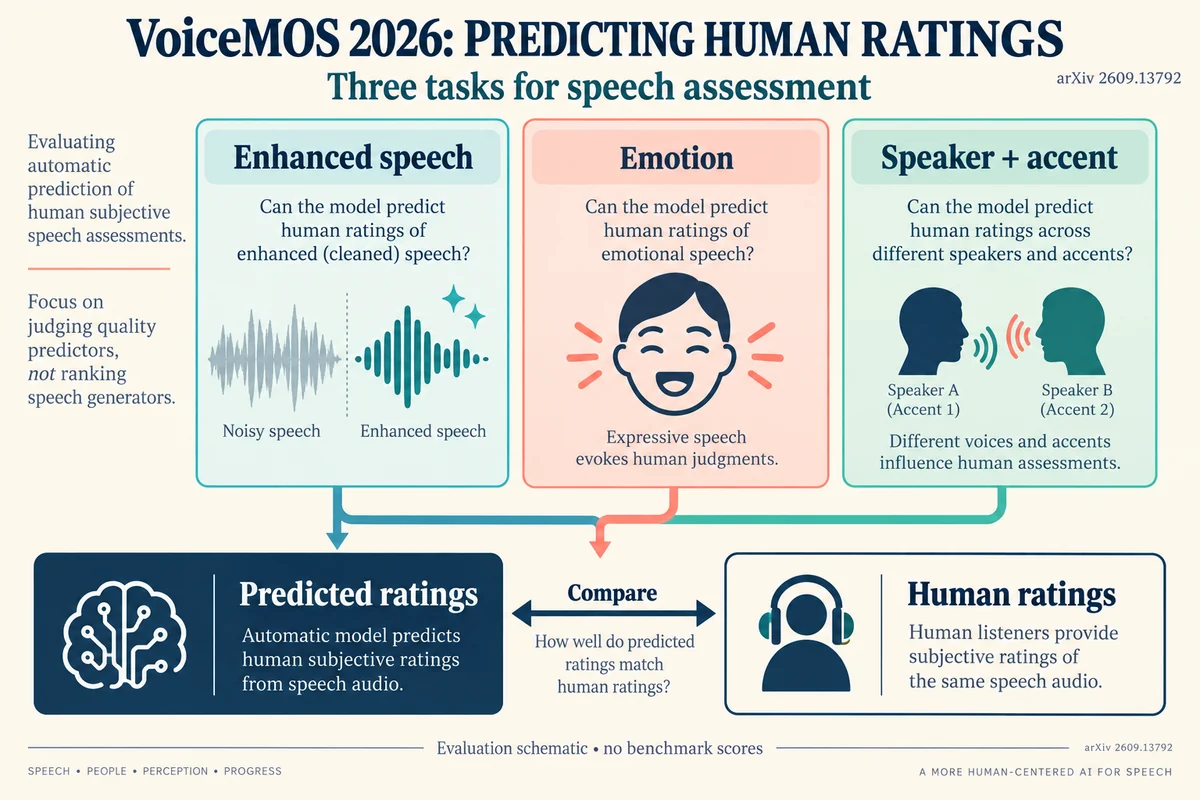
VoiceMOS 2026 evaluates systems that predict human assessments of speech. It is useful for understanding whether an automatic score reflects the quality dimension you care about. A model that estimates naturalness well may still need separate validation for emotion, accent similarity, or the difference between two nearly equal recordings.
Research reviewed September 17, 2026.
Understand the challenge before reading the rankings
The September 12, 2026 VoiceMOS preprint describes three tracks: enhanced-speech ratings, emotional-TTS assessments, and speaker/accent similarity for codec-based synthesis. The emotional track separates synthesis quality from emotion matching. The accent track includes outputs from systems unseen during predictor training. The authors report that most participating teams exceeded the provided baselines. Read the VoiceMOS 2026 report.
These are results about assessment models. They should not be presented as a ranking of which commercial voice generator sounds best. That distinction changes how the research can support a production decision.
Start with the listening question
Consider three original review prompts: “Does this sound natural?”, “Does this sound like the reference speaker?”, and “Does this delivery convey restrained excitement?” The same recording could receive different answers without any reviewer being inconsistent.
Before choosing a metric, write the question in ordinary language. Then decide what information a reviewer needs. Speaker similarity requires a reference. Emotion matching may require an intended emotion. General naturalness can be judged without either.
Avoid quietly changing the task between human and automatic evaluation. A listener who hears a reference and a model that receives only generated audio are working with different evidence.
For practical production review categories, begin with the voice-over quality assurance checklist, then narrow the criteria to the research question.
Distinguish ranking from calibration
Suppose an automatic predictor orders three samples correctly from weakest to strongest but assigns all three scores near the top of its scale. It may be useful for ranking while being poorly suited to an absolute release threshold.
Now suppose another predictor estimates average ratings reasonably but swaps the order of two close alternatives. It may support broad screening while being less useful for choosing between near-equivalent takes.
These are illustrative cases, not numerical VoiceMOS results. They explain why a single performance number cannot cover every use.
Evaluate both the ordering and the size of errors. Inspect whether predictions systematically overrate certain styles, underrate particular speakers, or compress distinctions into a narrow score range. If the intended use is selecting the better of two versions, test that decision directly.
Build a small local validation set
Prepare consented speech samples spanning the content you actually publish. Include acceptable recordings, clear failures, and borderline examples that require judgment.
Write a short rubric for each dimension. For example, naturalness could focus on phrase continuity and plausible delivery, while content accuracy checks whether required words are present. Avoid mixing these into a single unexplained score.
Have reviewers work independently before discussing results. Keep model names hidden and vary presentation order. Record the number of judgments per sample and preserve disagreement.
The set should include material from the intended audience's languages and accents. Do not assume that a predictor validated on one collection transfers unchanged to another. A small local set will not establish universal validity, but it can reveal obvious mismatches before a score becomes part of a release process.
Investigate disagreement instead of hiding it
When a predicted score and listeners disagree, replay the sample with the rubric visible. Ask whether the model is measuring a different property, whether the instructions were ambiguous, or whether the sample contains an unusual combination of strengths and weaknesses.
An energetic delivery might be expressive yet difficult to understand. A voice might resemble a reference speaker while changing the accent. A technically clean recording might have misplaced emphasis.
Keep these cases as an audit collection. They are more useful than repeatedly demonstrating that the predictor recognizes obvious noise.
Also examine human disagreement. If listeners interpret the requested emotion differently, an averaged label may conceal a problem with the task definition. The right next step may be clarifying the brief rather than tuning the predictor toward a noisy target.
Use automatic scores at the right decision point
Automatic assessment can help prioritize recordings for review, compare experiments, or monitor shifts across a large collection. Each use needs its own validation.
For triage, test whether the system reliably brings material problems to a human reviewer. For experiment comparison, check whether the preferred configuration remains preferred across speakers and content types. For monitoring, keep the input mix stable enough that a score shift can be interpreted.
Avoid treating a predicted rating as a fact about a particular listener's experience. It is an estimate produced under a learned assessment process.
Our guide to making AI voices sound natural addresses editing decisions after listening. An automatic score may point toward a clip worth inspecting, but it does not explain which sentence needs a rewrite.
Report what the predictor can support
A useful assessment report names the predicted dimension, the reference information supplied, the validation material, the human rubric, and the intended decision.
State whether the evaluation concerns individual recordings or averages across systems. A predictor that gives useful system-level summaries may still be unreliable on one difficult sentence.
Include examples of disagreement and the proportion of material sent for human review. If the tool is used as a gate, document the threshold and the consequences of false passes and false failures.
The main practical lesson from this research area is to match the assessment to the task. VoiceMOS 2026 provides a concrete research setting for that question. Our recommended use is narrower than “trust the score”: validate the score against the listening decision, retain evidence of its limitations, and revisit that validation when the voices, content, or audience change.
Try Our Voice Clone Demo
Hear your words come to life
Choose a voice and try a short preview.
Listen to sample voices
Hear examples before choosing a voice. Generated results can vary with the script and reference sample.
Looking for another voice?
Explore the library and listen to a sample before you create.

Morgan Freeman

Stephen Hawking

Christiano Ronaldo

Donald Trump

Kokoro

Disney XD Announcer

Cute Japanese Girl
Vin

Adam Stone
Transform Your Content with AI Voice Technology Today
Try a short voice preview, then create speech and save your audio in a workspace built for your next project.
Generate Your Voice Now