
X-Voice Research: Cross-Lingual Cloning Without Reference Text
Examine X-Voice's transcript-free reference method, multilingual training choices, and practical tests for pronunciation, accent, and speaker identity.
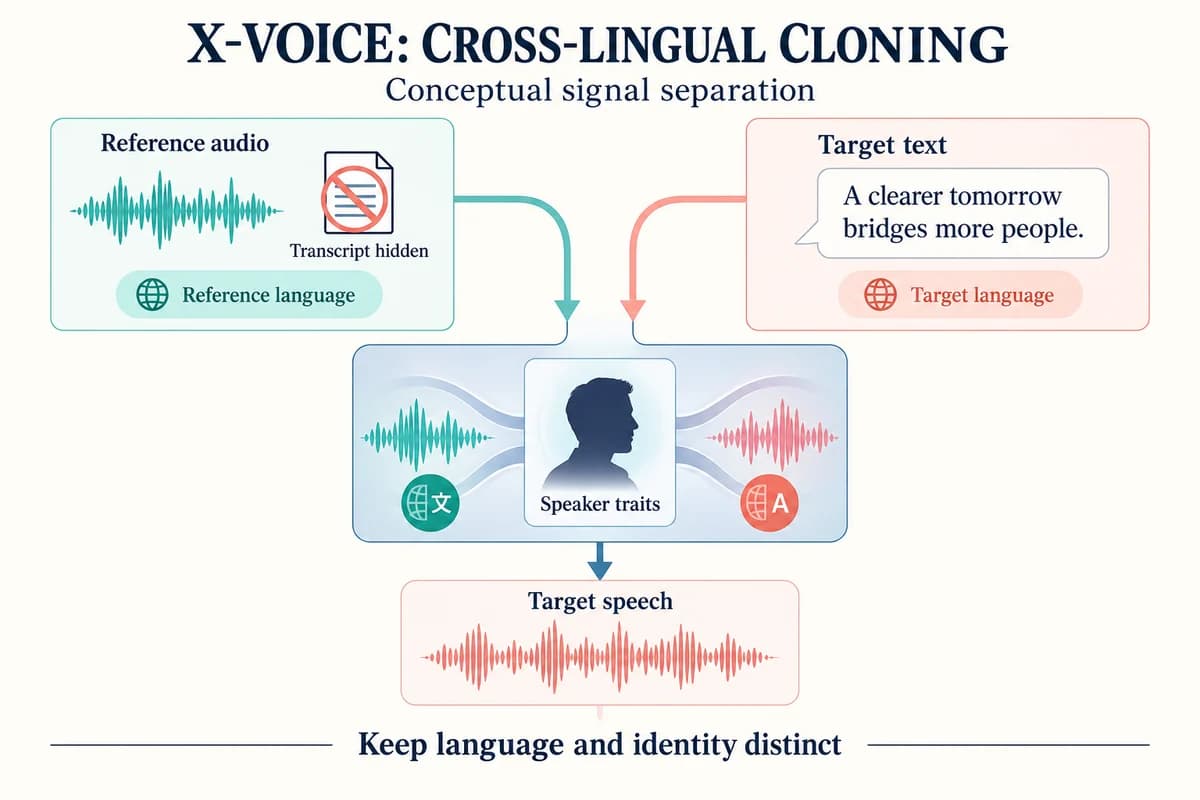
X-Voice studies a practical obstacle in multilingual voice cloning: the reference recording may be available even when an accurate transcript is not. Its second training stage removes the need to supply reference text, while the target text still tells the system what new speech to generate.
Research reviewed September 17, 2026.
That distinction is central. Transcript-free reference conditioning does not mean text-free synthesis, automatic translation, or guaranteed recognition of every accent. It changes one part of the input workflow. The rest of the system still needs to produce the intended words in the intended language.
Identify the problem the paper addresses
The May 7 X-Voice paper, revised May 9, presents a 0.4B flow-matching model covering 30 languages. Its two-stage approach first builds a multilingual foundation, then uses synthetic reference prompts during fine-tuning while masking their text. The goal is to preserve useful voice information without requiring a reference transcript.
This is valuable to examine because obtaining a recording and accurately transcribing it are different tasks. A spontaneous clip may contain hesitation, code-switching, or unfamiliar names. A workflow that requires a perfect transcript can add preparation work before generation begins.
Removing that requirement may simplify setup. Whether it preserves the desired identity and delivery is an empirical question, not something established by the smaller input form alone.
Follow the training idea without confusing the stages
In the paper’s design, the first model helps construct the examples used to train the second. That means synthetic speech is part of the route toward a reference-text-free model, rather than evidence that users must synthesize their own reference before every request.
The authors also use language conditioning and a multilingual phonetic representation, with language-specific frontend choices. Their detailed method distinguishes these components from the transcript-removal stage. The full paper provides the architecture and ablations.
For a research reader, ablations matter because several changes occur together. A final model’s result does not reveal which change caused an improvement. Look for comparisons that remove or modify one component while keeping the experiment otherwise similar.
Do not turn an architectural rationale into a claim that all preprocessing problems have disappeared.
Check the released input contract
The official X-Voice repository provides the implementation and links to the released resources. Use its checkpoint and inference instructions to identify which stage and mode you are testing.
Before a pilot, write down the required inputs in plain language: target text, target language, reference recording, and any optional information. Verify that the chosen checkpoint is the one intended for the transcript-free workflow.
This prevents a deceptively common mistake: evaluating a family’s older or differently configured model while attributing the result to its newer method. It also helps a reviewer understand whether an external transcriber or frontend was included in the test.
Save the original reference unchanged. If you trim or clean it, retain the edited copy with a clear name and document that choice.
Compare preparation effort as well as audio
A useful proposed experiment compares two complete workflows, not only two final files. In one, the reference requires manual transcription and checking. In the other, the reference is supplied without text through the supported mode.
Use the same consenting speakers and target sentences. Record preparation time, generation time, rejected outputs, and review time. A reduction in transcription work is valuable only if later corrections do not outweigh it for the project.
For example, a short reference in a familiar language may be quick to transcribe. A mixed-language recording may be harder. Keep those cases separate rather than averaging them into a single claim.
The reference recording guide can help ensure the audio itself is suitable. Transcript-free conditioning is not a reason to use an avoidably noisy or unrepresentative clip.
Separate language accuracy from accent identity
A cross-language clone raises at least two questions: does it sound like the reference speaker, and does it speak the target language appropriately? A third may concern the accent the project wants to preserve or change.
Define those expectations before listening. For an educational explanation, target-language clarity may be the priority. For a character performance, some accent continuity may be intentional. Neither expectation should be silently substituted for the other.
Use reviewers qualified for each judgment. A person who recognizes the source speaker may not be able to assess subtle pronunciation problems in the target language.
A review table can record:
| Dimension | Concrete observation |
|---|---|
| Identity | The voice resembles the approved reference |
| Content | Names and instructions are spoken correctly |
| Language | Rhythm and pronunciation fit the intended audience |
| Accent goal | The requested accent behavior is maintained |
Challenge references that differ in useful ways
Start with a clean baseline. Then compare references from the same speaker that vary in a controlled way: a shorter passage, a different delivery, or another language the speaker legitimately uses.
Keep the target text fixed. Do not change the reference, target language, and sentence difficulty simultaneously if you want to understand the cause of a difference.
Listen for contamination from the reference’s content or environment. Does the output introduce words that were not requested? Does the delivery copy an emotional quality that does not fit the target sentence? These are proposed failure checks, not claims that X-Voice necessarily exhibits them.
Repeat the test with several speakers before drawing a broad conclusion. One easy reference can make a workflow look more dependable than it is across the material a team actually receives.
Report a bounded cross-language result
Use the multilingual workflow to preserve scripts, reference permissions, reviewer notes, and accepted outputs. Add checkpoint identity, frontend configuration, and whether reference text was supplied.
A useful report explains which language pairs were tested and which were not. It identifies the content types and the role of human review. It does not describe every supported pair as equally validated.
X-Voice contributes a specific approach to removing reference-transcript dependence while maintaining a multilingual cloning objective. The practical opportunity is a simpler preparation path. The practical responsibility is to verify that the resulting words, accent behavior, and voice identity remain suitable for the intended audience.
That combination of workflow measurement and listening review gives the research a meaningful test beyond the convenience of omitting one input field.
Try Our Voice Clone Demo
Hear your words come to life
Choose a voice and try a short preview.
Listen to sample voices
Hear examples before choosing a voice. Generated results can vary with the script and reference sample.
Looking for another voice?
Explore the library and listen to a sample before you create.

Morgan Freeman

Stephen Hawking

Christiano Ronaldo

Donald Trump

Kokoro

Disney XD Announcer

Cute Japanese Girl
Vin

Adam Stone
Transform Your Content with AI Voice Technology Today
Try a short voice preview, then create speech and save your audio in a workspace built for your next project.
Generate Your Voice Now