
MOSS-TTS Research: Why the Local Transformer Matters
Compare MOSS-TTS's delay and local-transformer designs, understand checkpoint differences, and plan meaningful tests of speaker consistency and control.
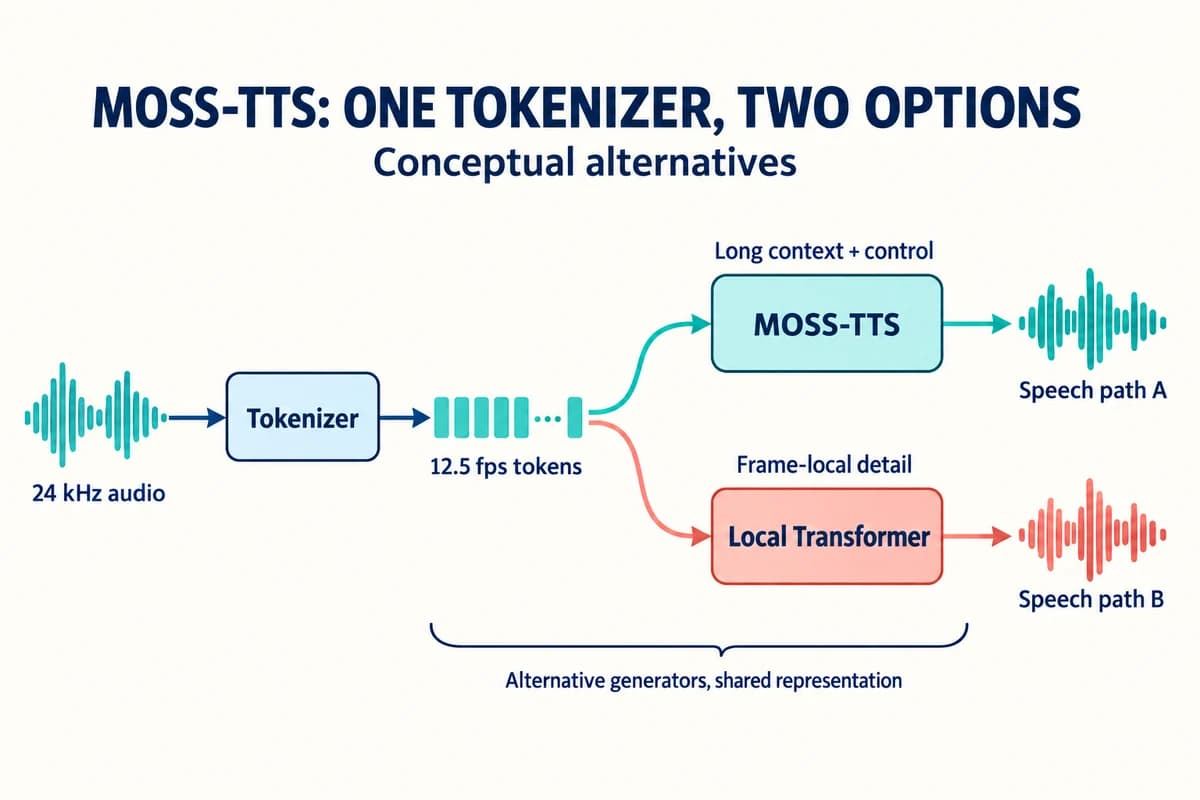
MOSS-TTS is worth studying as a comparison between two ways of organizing speech generation. One favors a relatively simple delayed arrangement of audio codes; the other adds a local transformer that expands each time step into a detailed block. The research asks what that extra structure changes for voice preservation and deployment.
Research reviewed September 17, 2026.
The practical lesson is to identify the architecture and checkpoint before interpreting a result. “MOSS-TTS” names a family, and its members do not automatically share every demonstrated strength. A narration team should compare the specific configurations that fit its work.
Follow the two decoding paths
The March 2026 MOSS-TTS report presents a delay-pattern generator and a local-transformer generator using a shared speech-tokenization foundation. In the local design, the main backbone produces a representation for an aligned step, and a smaller autoregressive component expands the within-step token block.
An intuitive distinction is between organizing the details along a shifted timeline and assigning a separate component to elaborate each moment. This is an architectural explanation, not a claim that one arrangement always produces better speech.
The design invites a useful engineering question: where should the expensive sequence model spend its effort? Across a long passage, within each acoustic frame, or in some combination? The answer affects implementation as well as the form of the modeling problem.
Respect the paper's division of evidence
The authors use the local-transformer variant chiefly to examine speaker preservation, while their control and very long generation evaluations emphasize the simpler MOSS-TTS backbone. Their reported results should be read with that division intact. The technical report PDF explains the architectural tradeoff and the evaluation allocation.
Do not move a duration-control result from one variant into a summary of another without checking that the released checkpoint supports the same behavior. Nor should a favorable speaker-similarity result become a blanket statement about every language or document length.
This is a common comparison problem: a family-level feature list can combine the best result from several configurations. A deployment uses one concrete configuration at a time. Its evaluation should reflect that.
Keep later releases separate from the original experiment
The official repository records a May 26 v1.5 release and a June 18 Local Transformer v1.5 release. It describes the latter as a 4B checkpoint using the second-generation audio tokenizer with native 48 kHz stereo output. Those release details should not be silently attributed to the original report’s smaller local model.
A version table in your notes should contain the paper date, checkpoint name, tokenizer version, and implementation commit. Leave a field blank when it is unknown rather than assuming the latest repository reflects the experiment you are discussing.
This also makes regression testing possible. If a new checkpoint improves a short audition but changes an existing character voice, you can identify what changed and decide whether to retain the previous version.
Compare continuation with a fresh utterance
For a narration project, identity is not the only continuity requirement. Pace, room character, emphasis, and sentence endings also influence whether a new passage fits earlier material.
Design a paired trial around an approved paragraph. In one condition, generate a new sentence using the intended cloning setup. In another, use the supported continuation workflow. Keep the target wording identical and document the different inputs.
Ask listeners which result fits the neighboring paragraph, then separately ask which resembles the reference speaker. Those answers may differ. A performance can resemble a voice yet still feel like a new recording session.
The audiobook chapter workflow provides a useful production context. Apply the comparison at chapter transitions and corrections, where inconsistent delivery creates real editing work.
Measure long-form behavior at meaningful boundaries
A model’s ability to produce a long file is only the beginning of a long-form test. Define what must remain stable across that file.
For a proposed history narration, include recurring names, dates, quotations, and section changes. Mark several checkpoints in the script. At each checkpoint, compare word accuracy, speaker character, and pace with the beginning.
Add a review at transitions between narrative and quotation. A voice may need a subtle expressive change while still sounding like the same narrator. A test consisting entirely of neutral prose would miss that requirement.
Count the corrections needed to make the whole piece publishable. A clean first minute and a high average score can coexist with an unusable final section. Report the location and type of problems instead of hiding them in an overall impression.
Evaluate controls as constraints on a task
Duration and pronunciation controls are useful when they solve a concrete production need. For example, a sentence may need to fit a fixed visual hold while preserving a difficult place name.
Prepare a target window with enough room for a natural reading. Then test whether the chosen checkpoint can approach that window without losing words, rushing a name, or adding conspicuous silence. Use the actual control interface documented for that release.
For pronunciation, supply an approved reading and review the resulting word in context. A correct isolated name can change when it appears beside an abbreviation or number.
A useful log has four columns: requested constraint, observed behavior, accepted result, and required correction. This distinguishes a controllable system from one that occasionally produces the desired timing by chance.
Decide which complexity is worthwhile
The local transformer adds a particular modeling structure. Whether that structure benefits your application depends on the accepted output, implementation support, and cost of maintaining the chosen path.
Test the same small corpus on the candidate variants when resources allow. Keep references and review criteria fixed, and include both ordinary and difficult passages. Document any different generation settings rather than implying a perfectly controlled architecture experiment when other factors also changed.
Use the quality assurance checklist on the final exports. Include wrong words, identity drift, unwanted pauses, and editing time in the decision.
MOSS-TTS offers a useful example of research that exposes a design choice rather than only publishing a single score. Its clearest practical value comes from matching that choice to a defined narration problem and preserving the version details needed to repeat the result.
Try Our Voice Clone Demo
Hear your words come to life
Choose a voice and try a short preview.
Listen to sample voices
Hear examples before choosing a voice. Generated results can vary with the script and reference sample.
Looking for another voice?
Explore the library and listen to a sample before you create.

Morgan Freeman

Stephen Hawking

Christiano Ronaldo

Donald Trump

Kokoro

Disney XD Announcer

Cute Japanese Girl
Vin

Adam Stone
Transform Your Content with AI Voice Technology Today
Try a short voice preview, then create speech and save your audio in a workspace built for your next project.
Generate Your Voice Now