
Voxtral TTS Research: Hybrid Speech for Voice Agents
Understand Voxtral TTS's hybrid speech architecture, streaming evaluation, voice adaptation, and model license before planning a voice-agent experiment.
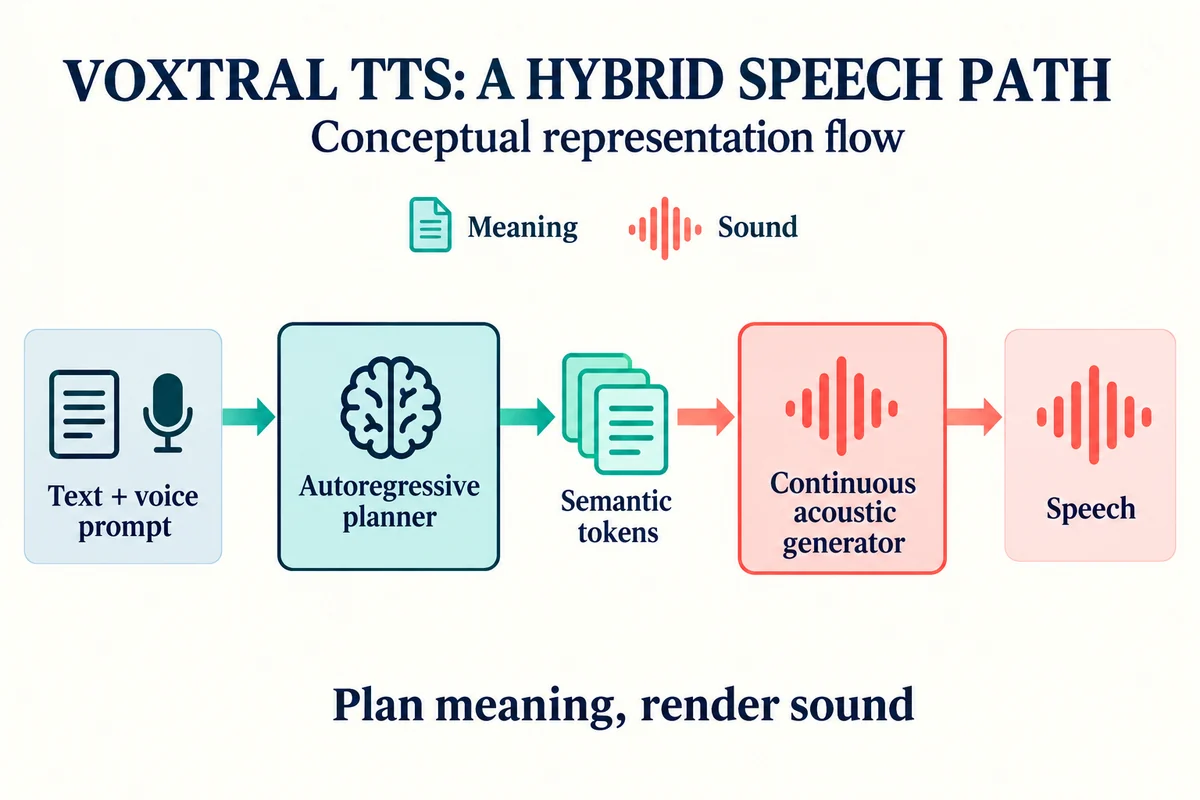
Voxtral TTS is worth studying because it combines a language-model backbone with a separate acoustic generator for responsive speech. The useful evaluation question is whether that combination produces an appropriate spoken response soon enough, consistently enough, for the conversation you want to build.
Research reviewed September 17, 2026.
This article reviews the research and release materials. It does not report an independent benchmark or imply that VocalCopyCat includes Voxtral.
What Mistral released
Mistral announced Voxtral TTS on March 23, 2026. Its description combines an autoregressive transformer backbone, a flow-matching acoustic module, and a neural audio codec. The backbone predicts semantic information; the acoustic component supplies the sound representation that the codec turns into speech. The launch covers nine languages. These are statements from the official announcement, rather than results reproduced here.
That division of work matters when discussing performance. A system can begin deciding what speech should contain before all acoustic detail is available. However, its practical responsiveness also depends on the audio player, network, scheduling, and surrounding application. Calling the model “streaming” does not specify the delay a person hears.
The accompanying Voxtral TTS paper provides the research reference. Keep the paper, checkpoint identifier, and inference software together in any experiment log.
Follow one response through the system
Imagine a booking assistant saying, “There are two available appointments. The earlier one is at ten thirty.”
A useful conceptual diagram has four boxes: Approved response text → Speech representation → Acoustic generation → Playback. This is a review aid, not an implementation specification. At every boundary, ask what is already committed and what could still change.
If the assistant receives a correction after “The earlier one is,” the application may need to cancel speech already queued. That is a different requirement from generating the original sentence quickly. Test cancellation separately from synthesis speed.
Likewise, a generated voice is only one component of an assistant. Speech recognition, business logic, text generation, and turn management need their own evaluation. Successful narration of a fixed sentence does not demonstrate successful conversation.
Measure the whole waiting experience
The model card reports latency on a single NVIDIA H200 using a specified inference stack and a 500-character input with a ten-second reference. Its results vary with concurrency. Those conditions make the figures interpretable; they are not a promise about a browser, laptop, or hosted application. See the official model card.
For an application trial, record four timestamps:
- The response text becomes available.
- The synthesis request starts.
- The first playable audio reaches the client.
- The client actually begins playback.
Also note whether playback later stalls. A quick first sound followed by a long gap may feel less coherent than a slightly later but continuous sentence.
Use both short acknowledgments and substantial answers. “Certainly” and a paragraph containing opening hours exercise different user experiences. Run the cases while the system handles one request and while it handles the expected workload. Keep cold starts separate from an already running service.
These measurements are a proposed evaluation method. No latency results are claimed here.
Test adaptation without confusing identity and delivery
A recognizable speaker can still sound inappropriate. Someone who resembles a reference voice might sound hurried in an explanation or overly cheerful when acknowledging a problem.
Create separate listening questions: does this sound like the intended speaker, are the words correct, and is the delivery suitable for the situation? Avoid a single “sounds good” score that hides disagreement.
Use recordings you are authorized to reuse. Keep a record of the reference, permitted purpose, and revision history; the voice-cloning permission checklist offers a practical starting point.
For a small pilot, choose three everyday interactions: a neutral confirmation, a correction, and a longer explanation. Ask reviewers to identify concrete problems, such as an unintended question-like ending or a pause that breaks a name. Preserve rejected outputs as well as preferred examples so the test reflects reliability.
Inspect multilingual details that a demo can hide
A language list is a starting point for selecting tests. It does not tell you whether a particular regional pronunciation, street name, or mixed-language product name will work.
Prepare the same interaction in each target language with a fluent reviewer. Localize the writing before generation. A literal translation can create a sentence that is grammatically valid yet awkward to say aloud.
Include a name, a time, and a short correction in each version. Ask reviewers to mark what they heard before showing the transcript. Then reveal the text and discuss whether the discrepancy came from pronunciation, wording, or playback.
Do not combine all language results into one average too early. A service intended for two audiences needs an acceptable experience for both. Record which language and script caused each failure so the next revision addresses the actual problem.
Keep the checkpoint license visible
The published weights carry a CC BY-NC 4.0 designation in the model card. They should not be described as commercially unrestricted. Access to weights and permission for a particular deployment are separate questions, and a hosted service can have different terms from a downloadable checkpoint.
Before choosing a deployment route, list the artifact you intend to use: weights, reference voices, service endpoint, or a third-party package. Read the terms attached to that artifact. This prevents an evaluation notebook from quietly becoming an assumption about production availability.
A useful internal decision record includes model version, approved use, reference provenance, hosting arrangement, and the person responsible for reviewing changes. Keep that record alongside the evaluation results, not in a separate forgotten document.
Decide with a conversation-shaped acceptance test
A convincing pilot should survive ordinary conversational friction. Include interruptions, corrections, repeated requests, and responses containing details people cannot afford to mishear.
For each case, define success before listening. An appointment time must be correct. A cancellation must stop promptly enough for the interface. A long explanation must remain intelligible through its final sentence. Set thresholds for your own application rather than borrowing an unrelated benchmark's headline.
Use the voice-over quality assurance checklist for the spoken output, then add application-specific checks for timing and interruption. Save the audio, input text, and environment details together.
The strongest reason to investigate Voxtral is its approach to responsive speech generation. The decision to use it should come from a repeatable trial of the actual conversation, supported by clear artifact and license choices.
Try Our Voice Clone Demo
Hear your words come to life
Choose a voice and try a short preview.
Listen to sample voices
Hear examples before choosing a voice. Generated results can vary with the script and reference sample.
Looking for another voice?
Explore the library and listen to a sample before you create.

Morgan Freeman

Stephen Hawking

Christiano Ronaldo

Donald Trump

Kokoro

Disney XD Announcer

Cute Japanese Girl
Vin

Adam Stone
Transform Your Content with AI Voice Technology Today
Try a short voice preview, then create speech and save your audio in a workspace built for your next project.
Generate Your Voice Now