
IndexTTS 2.5 Research: Expression, Speed, and Control
Explore IndexTTS 2.5's multilingual research, emotion and pronunciation controls, and release differences with a plan for evaluating expressive speech.
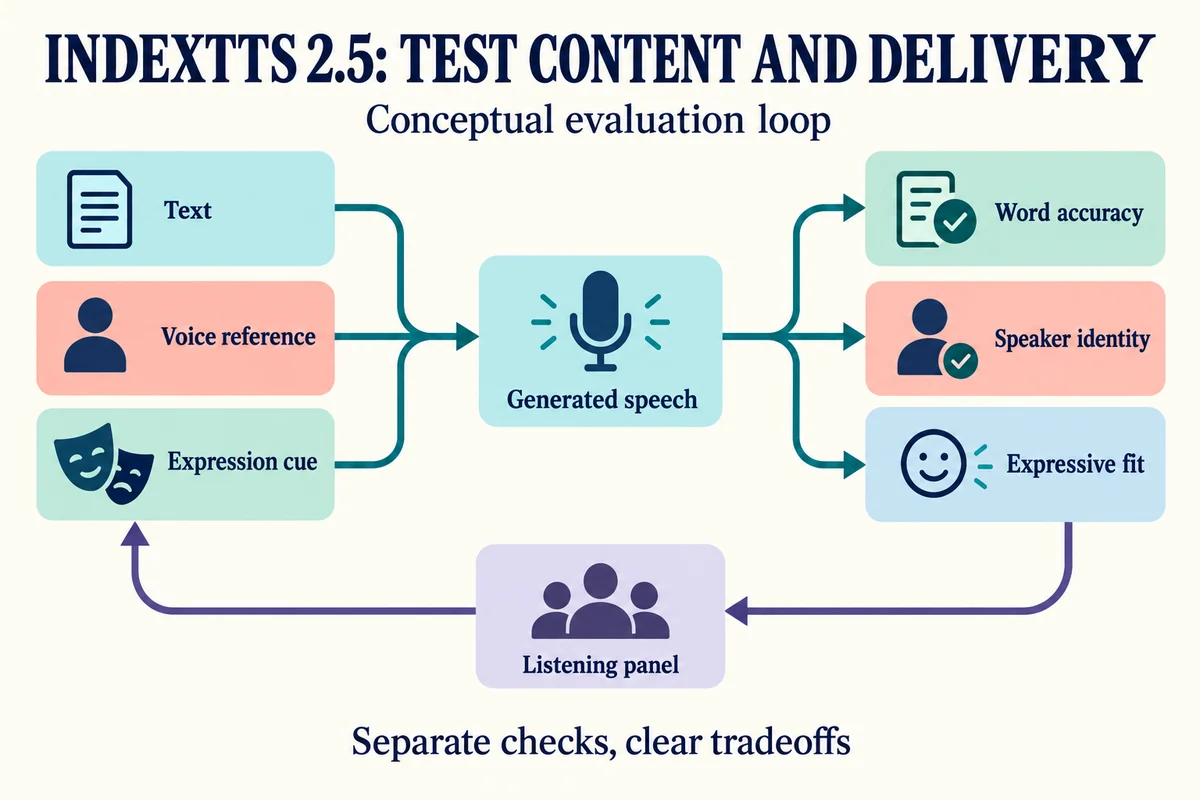
IndexTTS 2.5 is interesting for creators who need a voice to retain its identity while changing language, expression, or pace. Its research also shows why a model name alone is insufficient: the January technical report and the later released implementation describe different points in the project's development.
Research reviewed September 17, 2026.
This is a reading of the research and official release documentation, with a proposed evaluation workflow. It does not claim independent testing or availability inside VocalCopyCat.
Separate the report from the released version
The January 7, 2026 report describes a text-to-semantic module followed by a semantic-to-mel module. Its changes include reducing semantic sequence length, using a Zipformer-based acoustic stage, multilingual training strategies, and reinforcement-learning post-training. The paper evaluates Chinese, English, Japanese, and Spanish. Its speed improvements are author-reported under the stated experimental conditions. See the IndexTTS 2.5 technical report.
The official repository records an August 10 release with Arabic added to the supported language list. It also documents pronunciation and speaking-speed controls. That is useful evidence of release evolution, rather than a reason to rewrite the January paper's scope. See the official IndexTTS repository.
When comparing demonstrations, record whether they describe the paper, the downloadable release, or a service built around it. Those can differ in preprocessing, configuration, and postproduction.
Treat identity and emotion as separate goals
Consider a tutorial narrator who delivers an introduction warmly, explains a difficult step carefully, and celebrates completion with more energy. The desired identity stays stable while the delivery changes.
Build a three-column review sheet: Speaker identity, Emotional intent, and Text accuracy. A result can pass one column and fail another. A lively line that changes the recognizable voice is not equivalent to a controlled expressive performance.
Start with one short sentence that makes sense in several moods: “We can try that again.” Ask for restrained reassurance, neutral instruction, and visible enthusiasm only through controls documented for the implementation being tested.
Ask listeners what attitude they perceived before showing them the intended label. This catches the difference between the operator's expectation and the listener's experience. Do not infer emotional control merely because two outputs have different pitch or volume.
Make pronunciation corrections observable
The release documentation lists Pinyin, CMU phoneme, and Japanese Kana pronunciation controls. Treat those as version-specific interfaces, not universal notation that any speech tool understands.
For each difficult word, keep the intended spelling, intended pronunciation, surrounding sentence, and the model input used to achieve it. The ordinary spelling belongs in captions and editorial records even when a synthesis input uses a different representation.
A useful trial includes a brand name, a person's name, an abbreviation, and a word that changes pronunciation with context. Test each inside a complete sentence. A correction that works in isolation may disturb rhythm when embedded in a paragraph.
Our guide to fixing AI voice pronunciation explains how to keep these revisions organized. The research lesson is to evaluate controllability as repeatable correction, not as the existence of an extra field in an interface.
Avoid equating speed control with exact timing
The released repository describes a duration factor for adjusting speaking speed. That control should not be interpreted as proof that every sentence will land on a specified video frame. Changes to pace can also affect the listener's understanding and perception of emphasis.
Use a product demonstration with three visible actions: open a menu, choose an option, and confirm the result. Write the natural narration first. Then measure where its meaningful words fall relative to those actions.
If the line overruns, try a shorter script before demanding a much faster performance. “Select the export option from the menu” might become “Choose Export.” The second line preserves the instruction while giving the voice more room.
For final alignment, follow a voice-over synchronization workflow. Record both total duration and the timing of important phrases. Two clips of equal length can still guide the viewer differently.
Evaluate emotion transfer across languages carefully
A multilingual performance has at least three participants: the source speaker, the translated script, and the target-language listener. A problem can arise at any of those layers.
Choose one scene with a clear communicative purpose, such as politely correcting a misunderstanding. Have a fluent reviewer adapt it naturally in each target language. Then evaluate whether the generated delivery supports that purpose.
Keep the emotional request concrete. “Calm, patient explanation” gives a clearer review target than “more human.” Ask reviewers whether emphasis falls on the right words and whether the delivery sounds appropriate to the relationship between speakers.
Do not require identical rhythm across translations. A convincing performance may use different timing because the sentence structure differs. Conversely, a similar acoustic contour does not establish that the emotion carried across successfully.
These are proposed listening exercises, not evidence that any specific language pair will perform well.
Read efficiency claims as experimental comparisons
A reported improvement can explain why a research design matters without predicting your rendering time. Before using it for planning, identify the comparison model, hardware, numerical precision, input length, and whether preprocessing is included.
For a practical trial, time a fixed collection of scripts and count how many outputs are acceptable without regeneration. A fast generation that repeatedly needs replacement can consume more working time than a slower, reliable result.
Keep preparation, synthesis, listening, and repair as separate measurements. That breakdown shows whether a new model actually changes the production bottleneck.
Also save the exact software version. A later inference optimization can improve performance without changing the underlying paper, while an incompatible dependency can make an otherwise capable checkpoint awkward to evaluate. Document the working environment before interpreting differences.
Use a small matrix to make the decision
Choose two authorized reference speakers, three script types, and the languages relevant to the project. Include neutral narration, expressive dialogue, and terminology-heavy instruction. This creates a manageable pilot without pretending to cover every possible use.
For each output, mark content correctness, identity consistency, emotional suitability, pronunciation, timing, and required edits. Review a random order so the model label does not guide preferences.
Inspect repeated failures rather than only average scores. If names fail consistently, improve the pronunciation workflow. If emotional lines drift in identity, revise the reference or narrow the intended use. If timing suffers, revisit the script and edit plan.
IndexTTS 2.5 offers a useful case study in combining expression, multilingual generation, and efficiency. Its practical value depends on whether those controls produce the specific corrections your work requires, with a release version and evaluation record that another person can reproduce.
Try Our Voice Clone Demo
Hear your words come to life
Choose a voice and try a short preview.
Listen to sample voices
Hear examples before choosing a voice. Generated results can vary with the script and reference sample.
Looking for another voice?
Explore the library and listen to a sample before you create.

Morgan Freeman

Stephen Hawking

Christiano Ronaldo

Donald Trump

Kokoro

Disney XD Announcer

Cute Japanese Girl
Vin

Adam Stone
Transform Your Content with AI Voice Technology Today
Try a short voice preview, then create speech and save your audio in a workspace built for your next project.
Generate Your Voice Now