
LongCat-AudioDiT Research: Speech in Waveform Latents
Understand LongCat-AudioDiT's waveform-latent approach, its reconstruction tradeoff, and a practical listening test for faithful, intelligible voice cloning.
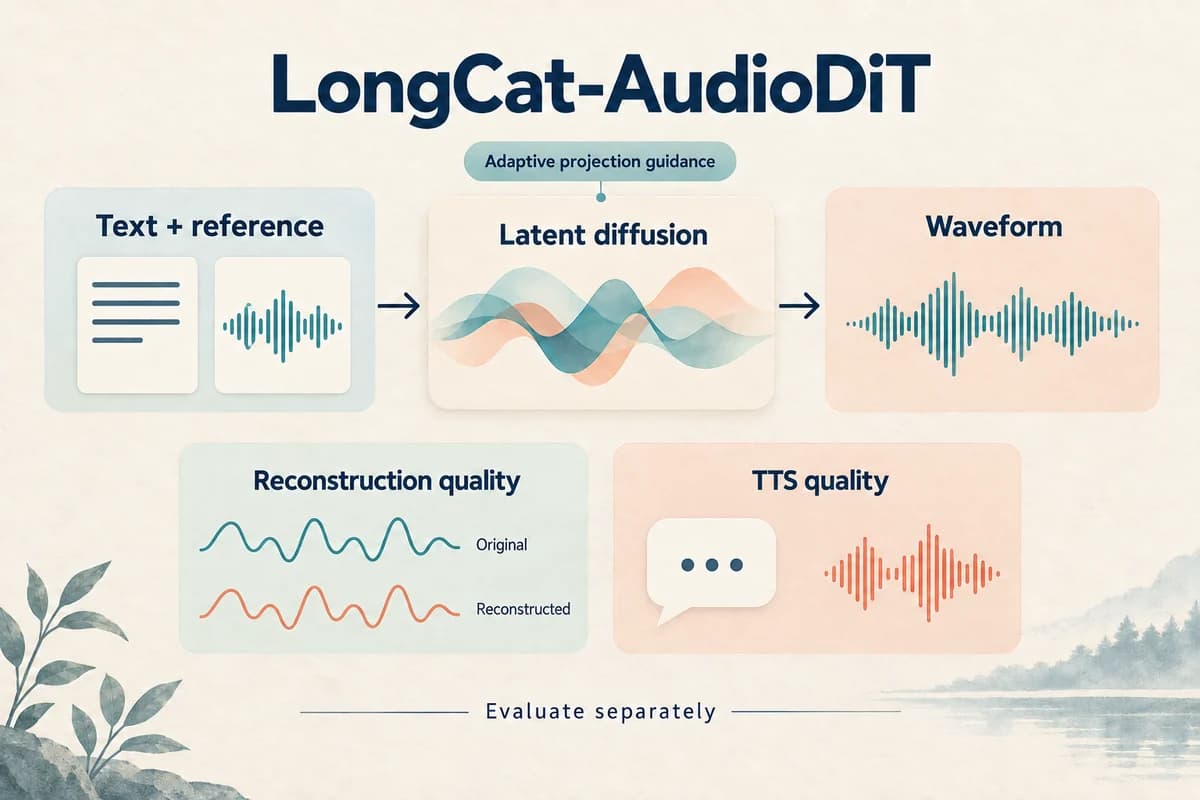
LongCat-AudioDiT asks whether a simpler audio representation can improve text-to-speech generation. Its key idea is to generate continuous waveform latents, then decode those latents into sound. For a creator, the useful consequence is a better question to ask of research demos: is the system good at reproducing audio, generating new speech, or both?
Research reviewed September 17, 2026.
This article interprets the published work and proposes listening tests. It does not present independent performance measurements or claim a VocalCopyCat integration.
Follow the two main components
The March 31, 2026 paper describes a waveform variational autoencoder and a non-autoregressive diffusion transformer. The diffusion model generates a continuous representation that the decoder converts into a waveform, without an intermediate mel-spectrogram generation stage. The authors also introduce changes to inference conditioning and guidance. See the LongCat-AudioDiT paper.
A helpful conceptual diagram has three labels: Text and reference → Continuous audio latents → Waveform. It describes the major idea without suggesting that users need to inspect latent values to produce speech.
The research is about the representation the generator learns. A WAV output file, by itself, tells you nothing about that internal representation. Different synthesis systems can deliver the same file format through very different processes.
Keep the internal method separate from the exported artifact when comparing tools or explaining the paper to a production team.
Distinguish reconstruction from generation
The paper's ablations report an important distinction: better waveform-autoencoder reconstruction does not necessarily produce better overall text-to-speech performance. That observation is about the authors' experiments, not a universal ranking of audio representations.
Reconstruction starts from an existing sound and asks how well it can be recovered. Generation starts from conditions such as text and a voice reference and asks for new sound. Those are different assignments.
Consider a reference sentence, “The train leaves after lunch.” A reconstruction test attempts to preserve that recording. A generation test might request, “Please meet us beside the ticket office.” The new sentence requires correct words, plausible timing, and recognizable identity, none of which is established by reconstructing the original sentence cleanly.
This distinction is useful beyond this model. Whenever a demo features an impressive codec example, ask to hear newly generated material as well.
Interpret the reported cloning results narrowly
The authors report results on Seed evaluation sets, including speaker-similarity improvements for their largest variant. Their reported training corpus centers on Chinese and English. A multilingual text encoder inside the architecture should not be treated as evidence that the released speech model performs equally across every language the encoder can process.
Avoid turning one similarity score into a percentage of how “identical” a speaker sounds. It is a metric computed under a particular evaluation procedure. A listener may still notice differences in pronunciation, rhythm, or emotional delivery.
For a project decision, inspect the relevant language and test type. A result on short benchmark utterances is evidence about those utterances. It does not automatically establish audiobook consistency or conversational responsiveness.
Use reported metrics to decide which model deserves a pilot. Use the pilot to decide whether the model suits the work.
Prepare a cloning experiment with clean inputs
The official repository provides one-billion and 3.5-billion parameter variants, inference examples, and cloning inputs that include prompt audio and prompt text. Check the example matching the version being tested.
For a first trial, choose one authorized speaker and a reference with a verified transcript. Include the actual spoken words, rather than a polished paraphrase. Keep the source recording unchanged in the experiment archive.
Create three target passages: familiar everyday speech, terminology-heavy instruction, and a paragraph with several sentence lengths. Do not use the same sentence as both reference and target when your aim is to understand generalization to new material.
Save the model identifier, input files, configuration, and original outputs. If you later clean or edit the audio, preserve that as a separate version. Otherwise a listening comparison can quietly become a comparison of editing effort.
Listen for content and texture separately
Run the first listening pass with the transcript hidden. Write down uncertain words and audible distractions. Then reveal the script and check omissions, repetitions, substitutions, and endings.
On a second pass, focus on the sound: consonant definition, sustained vowels, breath transitions, and changes in room-like character. A texture issue can be distracting even when every word is recognized correctly.
Use a simple issue record:
- Location: the sentence and approximate time.
- Content: what was requested and what was heard.
- Sound: the specific audible problem.
- Impact: whether it blocks understanding or mainly affects polish.
- Action: regenerate, revise the input, edit, or reject.
The AI voice artifact guide helps turn these observations into practical repair decisions. Avoid labeling every unusual sound “diffusion noise”; listening alone rarely identifies the internal cause.
Test settings through controlled comparisons
The repository exposes guidance choices in its examples. Treat those as research controls with tradeoffs to inspect, not automatic quality upgrades.
Change one setting at a time, keeping the text and reference fixed. If generation is stochastic, retain several outputs for each condition. A single preferred sample does not establish consistent superiority.
For blind review, rename files so listeners cannot see which setting produced them. Alternate playback order. Keep volume comparable using the same review procedure, and listen to the unprocessed versions before evaluating a finished mix.
Record both quality and work required. If a setting slightly improves perceived identity but causes more failed words, the right choice depends on the use case. A factual tutorial and a brief character performance can reasonably prioritize different outcomes.
Decide whether the design improves your workflow
Before a larger trial, define what success would change. Perhaps it would reduce distracting texture, preserve an approved voice across new scripts, or require fewer replacements on difficult text.
Use the voice-over quality assurance checklist to establish a repeatable final review. Include the whole passage, not only the strongest sentence. Compare accepted outputs and rejected outputs so reliability remains visible.
A useful evaluation conclusion names both the benefit and the unresolved limit: for example, a hypothetical pilot might find convincing short narration but insufficient evidence about long chapters. That is a decision boundary, not a failure to choose a winner.
LongCat-AudioDiT's research contribution makes audio representation worth examining. The practical lesson is to evaluate the generated speech as a complete communication task, rather than assuming that cleaner reconstruction or a stronger similarity score settles every dimension of quality.
Try Our Voice Clone Demo
Hear your words come to life
Choose a voice and try a short preview.
Listen to sample voices
Hear examples before choosing a voice. Generated results can vary with the script and reference sample.
Looking for another voice?
Explore the library and listen to a sample before you create.

Morgan Freeman

Stephen Hawking

Christiano Ronaldo

Donald Trump

Kokoro

Disney XD Announcer

Cute Japanese Girl
Vin

Adam Stone
Transform Your Content with AI Voice Technology Today
Try a short voice preview, then create speech and save your audio in a workspace built for your next project.
Generate Your Voice Now