HybridEmo: Emotion Sequences Versus Blended Speech
Understand HybridEmo's distinction between emotion trajectories and blends, and design listening tests that check both timing and expressive balance.
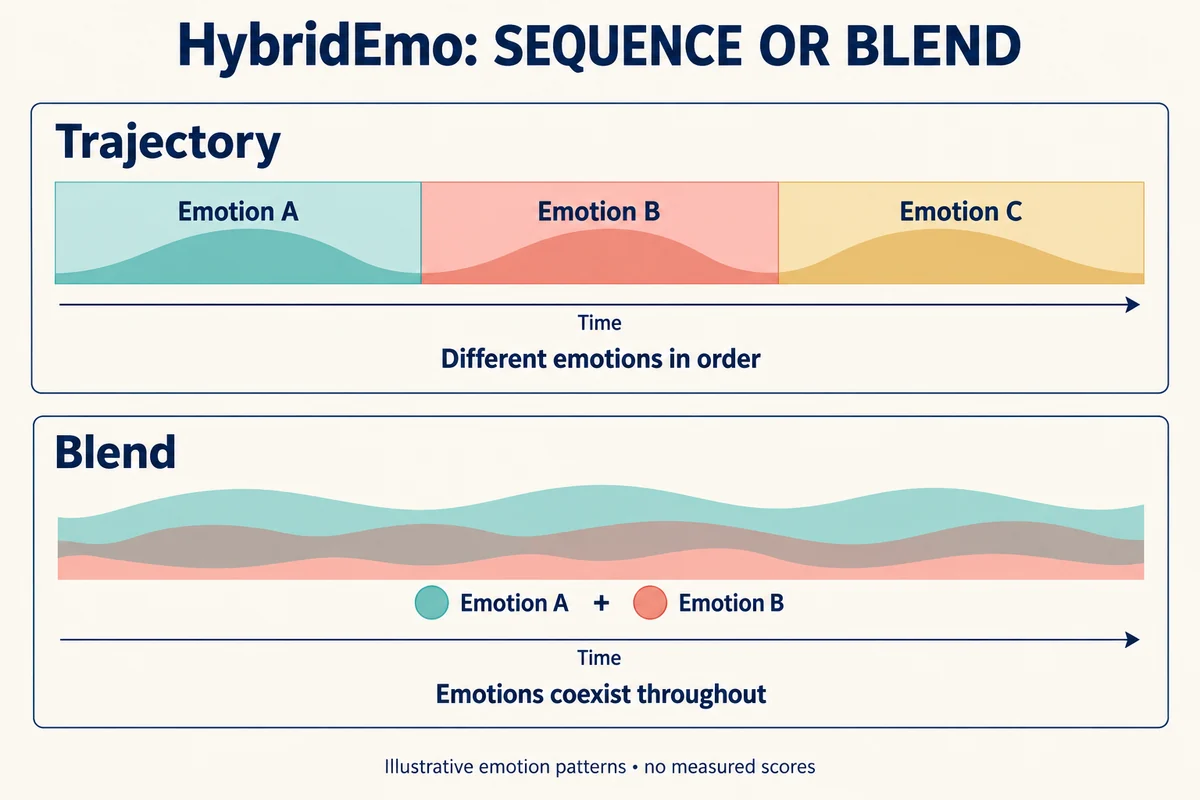
HybridEmo distinguishes two requests that can sound similar in a prompt but require different behavior: changing emotion across a sentence and conveying multiple emotions together. A useful evaluation must check the sequence in the first case and the coexistence of expressive cues in the second. An overall emotion label cannot fully describe either task.
Research reviewed September 17, 2026.
What the HybridEmo paper studies
Yan Zhou, Yun Hong, and Yang Feng submitted HybridEmo on August 31, 2026. Their post-training framework uses supervised fine-tuning followed by group-relative policy optimization, with different reward structures for ordered emotion trajectories and simultaneous blends. The authors evaluate on MultiEmo-Test and report improvements in trajectory completion and blending intensity. The paper treats these as related but distinct control problems. Read the HybridEmo paper.
The research concerns expressive control in a particular model and evaluation setup. It does not show that an emotion word has one universally correct sound or that every listener will interpret a performance identically.
Draw the requested emotion structure first
An original trajectory example could begin with uncertainty, move to recognition, and end with relief. Those states occur in an order. A blend might instead ask for relief with lingering concern throughout the same passage.
Before generating audio, sketch the request in plain text. For a trajectory, assign the intended state to each relevant phrase. For a blend, describe the overall situation and the qualities that should remain present together.
This helps identify ambiguous instructions. “Sound happy and sad” might mean alternate between the two, combine them, or move gradually from one to the other. The evaluation cannot resolve that ambiguity after the fact.
Treat this sketch as a performance brief, not a claim about the internal representation used by a model.
Use text that does not reveal every answer
A highly emotional script can make listeners infer the intended state from its vocabulary. That may be appropriate for storytelling, but it complicates a test of the sound itself.
Include neutral or lightly contextualized sentences alongside dramatic material. An illustrative line such as “I saw the message when I returned” can support several performances without explicitly naming an emotion.
Keep the same words across selected conditions. Then ask whether the requested change is audible when the lexical content stays constant.
Our voice-over script template can organize the approved wording and performance notes. For research, add a separate field stating which parts of the intended emotion should come from delivery rather than the script's literal meaning.
Evaluate a trajectory phrase by phrase
Play the complete utterance first, then let reviewers examine its sections. Ask whether the requested stages are present and whether they appear in the intended order.
A strong ending should not compensate for a missing middle stage. Keep a per-stage record alongside the overall preference judgment.
Also assess the transitions. A sequence can contain recognizable emotions yet sound like unrelated clips placed next to one another. Conversely, a smooth transition may make boundaries less sharply defined while still fulfilling the performance brief.
Decide in advance whether precise boundaries are required. A dramatic scene may allow gradual movement, while a controlled experiment may need specific text spans. The rubric should make that difference explicit.
Evaluate a blend without forcing a single label
For a blended request, ask reviewers about each intended quality separately before asking for an overall judgment.
An original example could ask whether a performance sounds both relieved and cautious. Reviewers should be able to report that one quality dominates or that neither is clear.
Avoid a forced choice between the requested emotions when the task is to express both. That question would contradict the intended output.
Use short comments to capture interpretations the rating scale misses. A listener might describe the voice as polite, uncertain, or restrained rather than selecting the exact terms in the prompt. Such disagreement may reveal ambiguity in the brief or limitations in the model, and those explanations should be investigated separately.
Check whether expression disrupts other qualities
Keep content accuracy, speaker identity, and listening comfort in the evaluation. A more dramatic performance is not automatically a more successful one.
Review whether stressed words remain understandable, whether the voice stays consistent across stages, and whether the delivery fits the intended audience. If a sentence is used in instruction or narration, excessive expression may distract from its purpose.
The existing guide to making AI voices sound natural addresses production listening. In an expressive-speech experiment, add the specific control brief so that naturalness and instruction fulfillment can be examined independently.
Retain examples where listeners prefer the baseline. They help reveal whether the requested emotional complexity adds value or merely makes the performance more noticeable.
Report control accuracy without claiming emotional truth
A study can report whether listeners perceived a requested performance under a defined rubric. That is a narrower and more defensible statement than saying a model “understands” the emotion.
Describe the language, text types, speaker references, reviewer instructions, and number of judgments. Include disagreement and cases where only part of a trajectory or blend was realized.
Our interpretation is that HybridEmo's most useful contribution is the task distinction. It encourages evaluators to stop treating all multi-emotion requests as one category.
A practical follow-up should therefore publish separate results for sequences and blends, preserve the scripts and briefs, and show complete audio rather than isolated successful moments. That makes it possible to judge whether a system follows expressive structure across an utterance while retaining the words and voice that the project requires.
Try Our Voice Clone Demo
Hear your words come to life
Choose a voice and try a short preview.
Listen to sample voices
Hear examples before choosing a voice. Generated results can vary with the script and reference sample.
Looking for another voice?
Explore the library and listen to a sample before you create.

Morgan Freeman

Stephen Hawking

Christiano Ronaldo

Donald Trump

Kokoro

Disney XD Announcer

Cute Japanese Girl
Vin

Adam Stone
Transform Your Content with AI Voice Technology Today
Try a short voice preview, then create speech and save your audio in a workspace built for your next project.
Generate Your Voice Now