
LoopTTS: Can an Audio Judge Improve Speech Repair?
Explore LoopTTS's judge-guided speech refinement, the limits of flagged-sample results, and a practical way to test whether corrections improve audio.
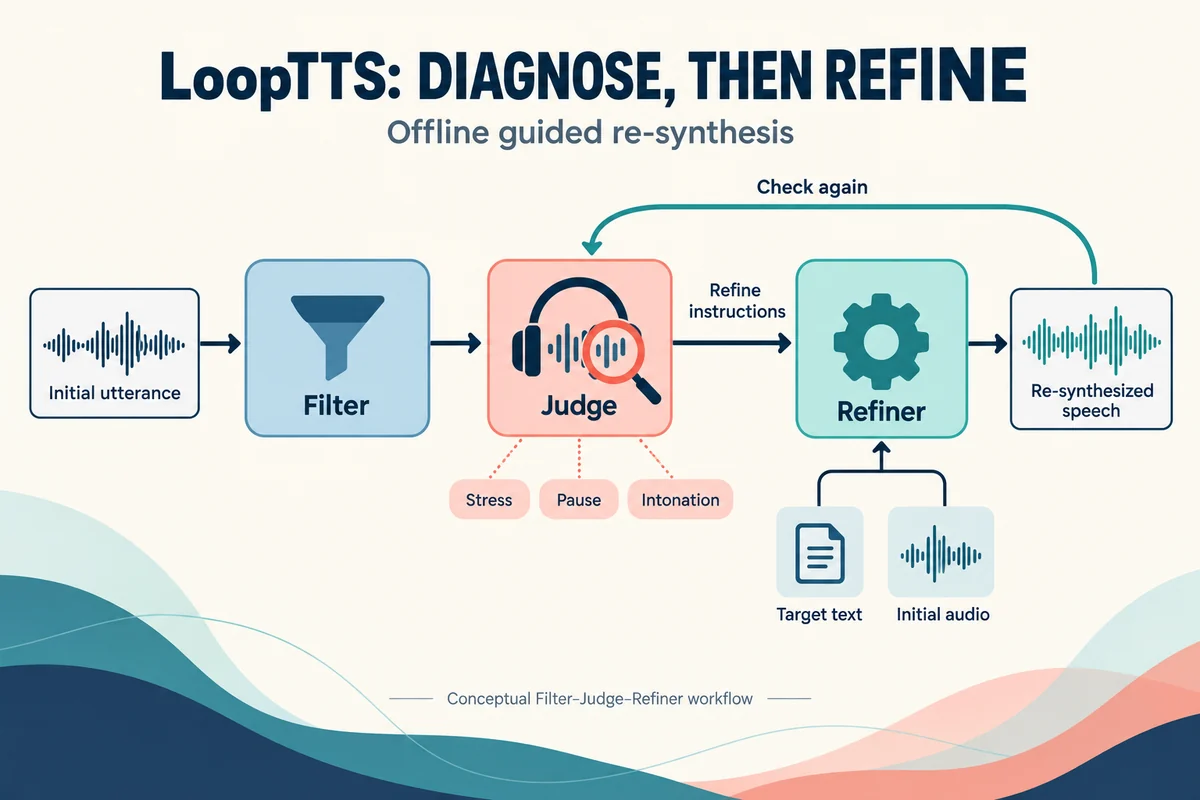
LoopTTS studies whether diagnosing a speech problem can make a second generation more useful than an unguided retry. Its core research question is specific: can an audio-aware judge identify a meaningful prosodic defect and provide instructions that help a refiner correct it? Answering that requires evaluating the diagnosis as well as the replacement audio.
Research reviewed September 17, 2026.
What the LoopTTS paper proposes
Zeyang Song and colleagues submitted the paper on August 29, 2026; its record lists acceptance to EMNLP 2026. LoopTTS uses an offline Filter–Judge–Refiner cascade. An AudioLLM diagnoses issues and produces instructions for guided expressive re-synthesis. The refiner uses the original utterance, text, and instruction; it does not perform waveform-local editing. Human recovery results are reported on judge-flagged low-quality utterances, with broader human evaluation identified as future work. Read the LoopTTS paper.
The distinction between selected failures and all generated speech is central. Improvement on difficult clips is valuable evidence, but its effect on a complete workload depends on how often those clips occur.
Make the diagnosis specific enough to act on
An original example is the sentence “We need the blue folder, not the green one.” A vague instruction such as “make this sound better” offers little basis for evaluating a repair.
A more testable diagnosis would identify the contrast and the affected words: emphasize the distinction between blue and green while retaining the sentence's meaning. That describes an intended change without claiming a particular acoustic realization is mandatory.
A diagnosis record should contain the text span, the perceived problem, the requested change, and what should remain stable. Keep subjective preferences separate from clear defects.
Our guide to AI voice artifacts helps distinguish content problems, pronunciation problems, and audio artifacts. A judge-led system should make equally clear distinctions before requesting another generation.
Test the judge before trusting its instructions
Select a mixture of clear defects, acceptable clips, and ambiguous performances. Ask independent reviewers whether the judge identified a real issue.
Measure false alarms as well as missed problems. A judge that finds something to change in every recording can produce many plausible instructions while still being unhelpful.
Review the location of the diagnosis. It matters whether the instruction targets the actual problem or a nearby phrase.
Also inspect whether the proposed correction preserves the intended meaning. An instruction to add emphasis can alter a contrast, and a pause can change how a sentence is interpreted. These are general evaluation concerns rather than claims about errors observed in LoopTTS.
Compare guided correction with a fair retry
For each diagnosed clip, save the original audio and create comparison conditions using a fixed correction budget.
One condition can use the diagnosis. Another can regenerate without that targeted instruction. If supported by the research implementation, an additional condition can use a human-written diagnosis.
Keep the approved text and reference information consistent. Otherwise, a comparison may reward a condition that received better source material rather than better guidance.
Use blind listening and randomize the order of versions. Ask whether the targeted problem improved, whether new problems appeared, and which version the reviewer would publish.
A corrected version should not automatically win because the evaluator knows it is the repair. The label itself can influence expectations.
Evaluate the complete workload as well as failures
A selected-failure study answers how well the system handles recordings already identified as problematic. A full-workload study adds several other questions.
How many recordings are flagged? How often are acceptable clips changed unnecessarily? How many errors pass through the filter? How much additional processing does the cascade require?
Keep those counts in a simple flow report: total inputs, passed unchanged, flagged, improved, unchanged after repair, and worsened after repair. Those are proposed reporting categories, not LoopTTS benchmark results.
This accounting makes the practical effect easier to estimate. A strong recovery rate on a rare subset may have a modest overall effect, while a small false-alarm rate can matter when applied to a large collection.
Check preservation alongside correction
A prosodic repair should be assessed for words, voice, timing, and continuity. Improving the targeted stress pattern does not establish that everything else remained acceptable.
Listen across the entire utterance. Compare speaker identity to the authorized reference and inspect any change in duration if the clip must fit a video.
Use the existing voice-over quality assurance checklist for the final review, but keep the targeted repair question as its own field.
Preserve the original version so that a human can reverse an unwanted change. In an experiment, retaining both versions also enables later review when a scoring method changes or a disagreement needs adjudication.
Decide where an audio judge belongs
A judge may be useful as a reviewer assistant even before it is reliable enough to trigger publication automatically. It can propose a location and a reason for inspection.
For that use, evaluate whether its notes save meaningful review effort and whether reviewers understand its uncertainty. A long, confident explanation is not evidence that the diagnosis is correct.
Our reading of LoopTTS is that diagnosis-guided re-synthesis deserves separate study from ordinary retries. The paper offers a concrete system for investigating that distinction, with an important boundary around the evaluated subset.
An adoption decision should therefore include judge accuracy, repair quality, preservation checks, full-workload accounting, and cost. The strongest outcome is not a collection of attractive repaired examples. It is evidence that the cascade consistently improves the recordings it changes while preserving the acceptable ones it encounters.
Try Our Voice Clone Demo
Hear your words come to life
Choose a voice and try a short preview.
Listen to sample voices
Hear examples before choosing a voice. Generated results can vary with the script and reference sample.
Looking for another voice?
Explore the library and listen to a sample before you create.

Morgan Freeman

Stephen Hawking

Christiano Ronaldo

Donald Trump

Kokoro

Disney XD Announcer

Cute Japanese Girl
Vin

Adam Stone
Transform Your Content with AI Voice Technology Today
Try a short voice preview, then create speech and save your audio in a workspace built for your next project.
Generate Your Voice Now