
Qwen3-TTS Research: Streaming, Cloning, and Control
Explore Qwen3-TTS model variants, streaming design, and voice cloning research, with practical ways to test latency, identity, and long-form reliability.
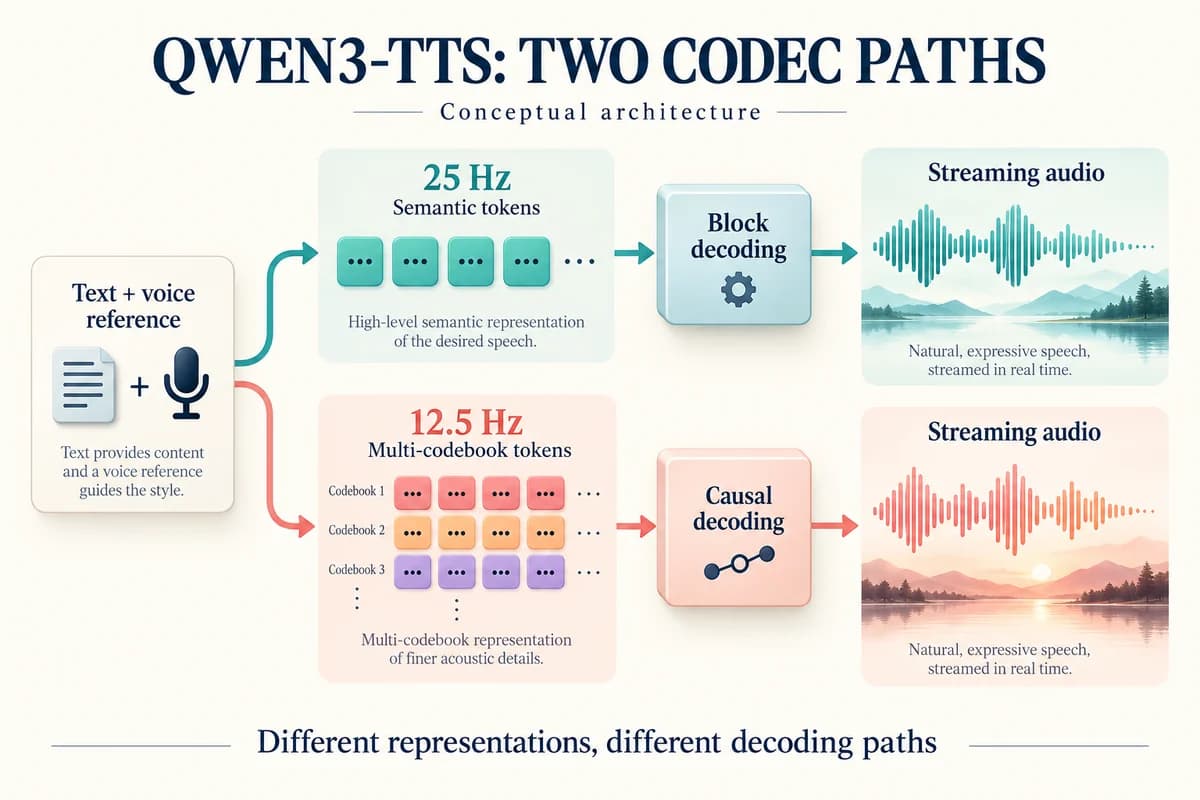
Qwen3-TTS is useful to study because it treats speech quality, voice identity, and streaming as connected engineering choices. Its model family offers different routes for cloning a reference voice, designing a voice from a description, and directing predefined speakers. Choosing the right variant matters before interpreting a demo or benchmark.
Research reviewed September 17, 2026.
This article examines the January 2026 research and its official implementation. The evaluation examples below are proposed tests, not measurements performed by VocalCopyCat. They are intended to help readers decide what evidence would matter for their own narration or interactive application.
Understand the research contribution
The January 22 Qwen3-TTS technical report describes a multilingual model family trained on more than five million hours of speech across ten languages. Its architecture combines language modeling with speech tokenization, and the report studies both a 25 Hz representation and a 12.5 Hz representation.
The interesting question is how the representation affects the work required before audio can play. A system does not become responsive solely because its language model predicts quickly. The generated representation also has to be converted into a usable waveform.
For a reader comparing systems, this suggests separating three decisions: what determines the voice, how speech is represented internally, and how audio reaches the listener. A short demonstration can make those decisions look like a single feature, even though changing one may alter the others.
Choose the model that matches the task
The official repository distinguishes Base cloning models from VoiceDesign and CustomVoice variants. Its cloning examples use reference audio with a transcript; an embedding-only option removes the transcript requirement, with a stated potential quality tradeoff. These are different input modes, not interchangeable labels for the same request.
A practical selection table can begin with the intended outcome:
| Intended outcome | Question to resolve first |
|---|---|
| Preserve a consenting speaker’s identity | Which reference mode is being tested? |
| Invent a voice for a fictional narrator | Is the checkpoint designed for descriptive voice creation? |
| Direct an available speaker | Which instructions does that variant support? |
Do not treat a result from one row as proof about another. A convincing designed voice does not establish identity similarity to a reference person. A recognizable clone does not establish precise control over emotion.
For the underlying distinction, see voice cloning versus text to speech.
Read streaming numbers as configuration results
The report’s 25 Hz path uses block-oriented reconstruction, while the 12.5 Hz path uses a causal decoder. Its efficiency table measures optimized implementations at different concurrency levels. The often-cited 97 ms first-packet result belongs to a particular 0.6B configuration and test setup; it is not a promise of that delay for every installation. The full report provides the configuration context.
For an application, measure the interval the user actually experiences. Record when text becomes available, when the request begins, when playable audio arrives, and whether playback then continues smoothly. These timestamps answer different questions.
Imagine two hypothetical systems. One starts quickly but pauses midway through a sentence; another starts slightly later and plays continuously. A single first-packet number would favor the first system while missing the interruption. Keep both startup delay and continuity in the evaluation.
Test reference quality without changing the script
Use a consenting speaker and a small reference collection. Begin with a clean, representative passage. Then compare another equally legitimate recording that differs in one relevant way, such as room sound or delivery.
Keep the target sentences unchanged. Otherwise, a difficult name in one run and an easy sentence in another can confuse the comparison. The voice cloning sample guide provides a practical way to prepare consistent references.
A useful test set contains a straightforward sentence, a question, a list, a proper name, and a paragraph with a change of topic. Ask reviewers to score identity, word accuracy, and delivery separately. Do not ask only which sample sounds “better.”
Save every generated result in the planned comparison, including weak attempts. Selecting the best of many generations for one model and the first generation for another produces a different experiment.
Challenge the transition from sentence to chapter
For a long narration, evaluate more than an attractive opening. Divide the output into sections and inspect whether names, pace, voice character, and sentence endings remain consistent.
One proposed test is a short museum guide with repeated place names. Introduce a name early, return to it midway through, and mention it again near the end. Have a reviewer listen without seeing the waveform and mark changes they notice.
Then inspect the transcript for skipped or repeated material. A smooth performance can still omit a qualifying phrase. An automatic transcription comparison can help locate candidates for review, but a human should resolve names and acceptable spoken expansions.
Keep the generation policy explicit. Whole-document synthesis and individually generated paragraphs are different workflows. Compare them as such, including the editing effort required to join sections.
Separate useful control from descriptive ambition
A voice prompt is most useful when its success can be judged. “Make it engaging” is difficult to evaluate. “Use a calm explanation, then make the final question sound like a genuine request for confirmation” gives a reviewer a clearer target.
Test one change while preserving the voice and wording. If the requested style improves but identity drifts, record both outcomes. They may represent an acceptable creative choice for one project and a failure for another.
Avoid packing contradictory directions into the same experiment. A brisk announcement and a hesitant confession have different performance goals. Start with a coherent brief, then increase complexity only after the basic control works consistently.
Use the voice quality checklist to keep linguistic correctness and listening quality visible alongside expressive control.
Make the result reproducible
Document the checkpoint, reference mode, exact text, instructions, implementation version, hardware, and generation settings. Include whether the model was already loaded and whether a reference had been processed previously.
The strongest conclusion is specific: a particular configuration produced acceptable output for a defined task under a recorded procedure. That conclusion is more useful than declaring a permanent winner across every kind of speech.
Qwen3-TTS provides a valuable case study in how model variants and decoding choices affect a speech workflow. Its research motivates careful testing of responsiveness and control; the final decision still belongs to the listener-facing result and the effort needed to produce it reliably.
Try Our Voice Clone Demo
Hear your words come to life
Choose a voice and try a short preview.
Listen to sample voices
Hear examples before choosing a voice. Generated results can vary with the script and reference sample.
Looking for another voice?
Explore the library and listen to a sample before you create.

Morgan Freeman

Stephen Hawking

Christiano Ronaldo

Donald Trump

Kokoro

Disney XD Announcer

Cute Japanese Girl
Vin

Adam Stone
Transform Your Content with AI Voice Technology Today
Try a short voice preview, then create speech and save your audio in a workspace built for your next project.
Generate Your Voice Now